


Desk clutter and scarce port selections often create immediate bottlenecks across modern computer setups. Plugging in multiple high-resolution displays, external backup drives, audio interfaces, and gaming peripherals quickly exhausts standard chassis connections. Selecting the best docking station for pc bridges this gap by routing dual HDMI feeds, Gigabit Ethernet, and multi-gigabit data channels through a single unified cable. This streamlined approach preserves desk space, simplifies cable routing, and maintains reliable signal distribution for home offices and gaming stations alike.
Hardware requirements depend on your visual workflow, peripheral load, and power distribution needs. High-wattage Power Delivery ensures connected laptops maintain steady charge levels under intensive gaming or creative sessions without throttling. High-speed USB-A and USB-C data ports keep external SSDs moving fast while leaving dedicated ports open for the best type of keyboard for gaming and responsive input gear. Reviewing port bandwidth, monitor resolution caps, and host system compatibility helps you assemble an organized, highly responsive setup built for long gaming sessions and uninterrupted productivity.


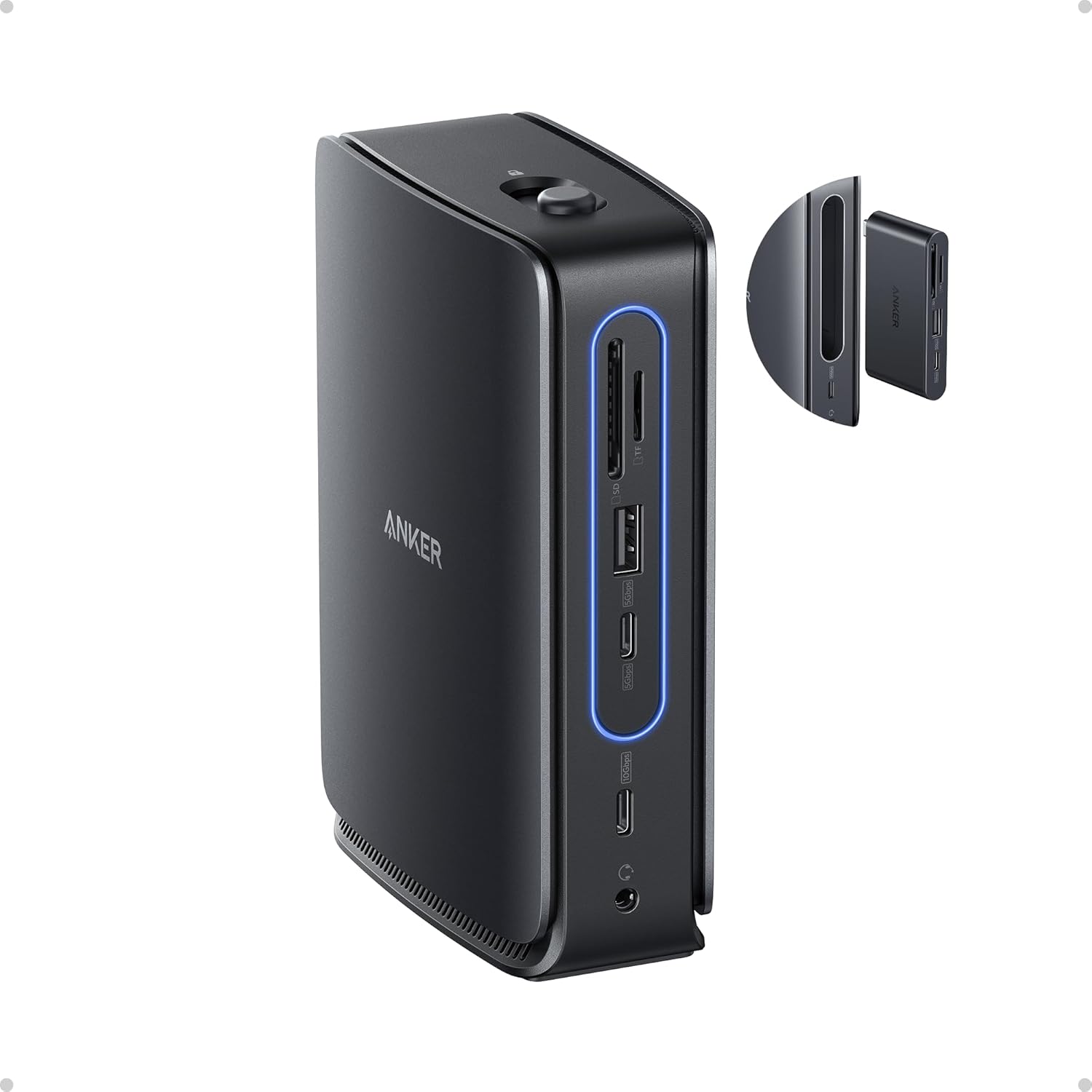
Pros
- Versatile dual-form design: full dock for desk setup, detachable hub for travel
- Triple 4K display capability enhances productivity and gaming immersion
- High 100W power delivery supports demanding gaming laptops
- Fast 10 Gbps data transfer speeds reduce wait times for large files
- Comprehensive port selection eliminates need for multiple adapters
Cons
- Some laptops may have port alignment issues where the hub blocks adjacent ports
- macOS users face mirrored displays on external monitors, not extended desktops
- USB-C upstream port does not support video output, limiting some configurations
The Anker Nano Laptop Docking Station (13-in-1, Triple Display, Built-In Removable Hub) is a smart addition for any PC gamer, streamer, or gaming setup builder looking to simplify connectivity. This dock combines a full-featured 13-port station with a detachable 6-port hub, letting you maintain a clean desk while staying flexible for on-the-go use. It's designed for USB-C laptops and works with Windows 10/11 and macOS 13.5 or above, making it a practical choice for diverse setups.
Who is this for? It's ideal for PC gamers who want to hook up multiple monitors for immersive gameplay or streamers juggling a gaming PC, capture card, and streaming peripherals. Competitive gamers will appreciate the reliable Ethernet port for low-latency connections, while content creators can benefit from the SD/TF card slots and fast USB-C data transfers. Casual gamers and college gamers will find the compact form factor perfect for dorm rooms or small desks.
Real-world performance stands out with triple display support via 2 HDMI and 1 DisplayPort, allowing up to 4K resolution on each screen. This is great for racing games, open-world titles, or multitasking with Discord, OBS, and game overlays. The 100W Power Delivery keeps your laptop charged during long sessions, and the 10 Gbps USB-C ports handle high-speed data from external SSDs or gaming mice. The detachable hub retains all dock functions when removed, so you can quickly grab your laptop without unplugging everything.
Build quality is solid with a compact aluminum-like finish and a sleek light strip that glows blue when connected. The included 140W power adapter and 3 ft USB-C cable are well-made, though the cable length may be short for some desk arrangements. The dock's 3.74 x 1.57 x 5.51 inch footprint is small enough to fit beside a monitor stand or under a desk mount. Setup is plug-and-play on Windows, but macOS users should note that external monitors mirror content rather than extend the desktop.
Ease of use is a highlight: just connect the USB-C upstream cable to your laptop, attach the power adapter, and you're ready. The detachable hub clicks in and out with a button, making it simple to switch between desk and mobile modes. Cable management is straightforward with the compact power brick and included cable. One realistic limitation is that some laptops with side USB-C ports may have the hub block adjacent ports, so checking dimensions beforehand is wise. Also, the USB-C port does not support video output, so you'll rely on HDMI and DisplayPort for monitors.
Overall, the Anker Nano Docking Station is a practical investment for gamers and creators who need a reliable, space-saving dock with flexible connectivity. It's especially useful for those with a single USB-C laptop who want to expand to a triple-monitor gaming setup or streamline their streaming gear. If you prioritize clean desk organization and versatility without sacrificing performance, this dock is worth considering.
This dock offers 13 ports in total: 2 HDMI, 1 DisplayPort, 2 USB-C data ports (10 Gbps), 3 USB-A data ports, Ethernet, audio jack, SD and TF card slots, and a DC input. The detachable hub adds 6 essential ports for mobile use. All ports work simultaneously, though macOS limits external displays to mirroring. The Ethernet port provides stable wired internet for competitive gaming or streaming.
The Anker Nano features a sturdy plastic and metal construction with a compact footprint. The light strip indicates connection status and adds a modern look. The detachable hub mechanism feels secure with a click-in design. Included accessories: a 140W power adapter with built-in 5 ft cord and a 3 ft USB-C to USB-C cable. The overall build is durable enough for daily desk use and occasional travel.

Pros
- Triple monitor support (2x HDMI + DP) for immersive gaming or productivity.
- Fast charging up to 85W for laptop plus 18W for phone/tablet simultaneously.
- 10Gbps data ports and gigabit Ethernet ensure low latency and quick file transfers.
- Worked reliably with Windows and Linux laptops according to user reviews.
- Solid build quality and compact footprint save desk space.
Cons
- MacOS only supports mirrored displays across external monitors, not extended desktops.
- Some Dell laptops may show a slow-charging warning due to proprietary charging protocol.
- Occasional reports of SD card slot being tight or malfunctioning after extended use.
The Anker 13-in-1 USB-C Docking Station (PowerExpand) is a comprehensive hub designed to turn a single USB-C port on your laptop into a full-fledged desktop workstation. For PC gamers, streamers, content creators, and even work-from-home professionals, this dock delivers the connectivity you need without breaking the bank.
Best suited for Windows users, this dock excels at driving up to three external displays at 1080p 60Hz via its dual HDMI and single DisplayPort outputs. That means you can have your game on one screen, Discord or streaming software on another, and a browser or chat on the third – a huge productivity boost for competitive and casual gamers alike. The 85W power delivery keeps your laptop charged during long sessions, while a separate 18W USB-C port can fast-charge your phone or tablet.
In terms of performance, the dock provides 10Gbps USB-C and 5Gbps USB-A data ports, so transferring large game files or video projects is snappy. Gigabit Ethernet ensures a stable, low-latency connection for online gaming and streaming, which is especially valuable in dorms or homes with spotty Wi-Fi. Setup is genuinely plug-and-play on Windows 10/11 – just connect the included USB-C cable and you’re ready to go. Linux support is also reported to work well with many distributions.
Build quality is typical of Anker: solid, compact, and with a rubberized base that prevents sliding. The power button is a nice touch, letting you cut power to all peripherals at once. However, there are a few limitations to consider. First, macOS users will find that all external monitors mirror the same content instead of extending the desktop – a macOS limitation, not the dock’s fault. Second, some Dell laptops may trigger a slow-charging warning because Dell uses a proprietary charging protocol; the dock still charges the laptop, but at a reduced rate. Finally, a small number of users had issues with the SD card slot being too tight or failing over time.
Overall, the Anker 13-in-1 USB-C Docking Station is a practical investment for any PC gamer or streamer who needs more ports and multi-monitor support from a modern laptop. It’s especially valuable for competitive gamers who want low-latency Ethernet, content creators who need fast file transfers, and any setup builder aiming to reduce cable clutter. Just make sure your laptop’s USB-C port supports DisplayPort Alt Mode and Power Delivery for full functionality.
The Anker 13-in-1 dock is a connectivity powerhouse. It includes: 1x USB-C port with 85W Power Delivery for laptop charging, 1x USB-C port with 18W PD for fast device charging, 1x USB-C data-only port at 10Gbps, 3x USB-A ports (one at 10Gbps, two at 5Gbps), 2x HDMI ports (4K@30Hz single or 1080p@60Hz triple), 1x DisplayPort (same resolution capabilities), 1x gigabit Ethernet jack, SD and microSD card slots (UHS-I), and a 3.5mm combo audio jack. This array covers virtually every peripheral a gamer or streamer might need: keyboards, mice, headsets, microphones, capture cards, external drives, and monitors.
This dock works with Windows 10/11, Chrome OS, and most Linux distributions that support USB-C DisplayPort Alt Mode and Power Delivery. It’s compatible with USB-C, USB4, and Thunderbolt 3/4/5 ports that follow the same standards. Mac users are supported but limited to mirroring external displays due to macOS Single Stream Transport (SST) restrictions. The dock is not compatible with Linux, according to the manufacturer’s note, but user reviews indicate it works well with Ubuntu and other distros. For best results, use the included USB-C cable, as third-party cables may not support full 85W charging.

Pros
- Consolidates up to nine USB peripherals, wired networking, and audio through a single laptop cable.
- Built-in GaN AC-DC power supply eliminates the need for an external power brick.
- Smart screen interface gives direct visual feedback on per-port wattage draw.
- Compact vertical footprint measuring 5.51 by 3.82 inches saves desk space.
Cons
- macOS systems only support mirrored external displays across both HDMI ports.
- Incompatible with Linux operating systems and cannot charge Lenovo Legion gaming laptops.
- Downstream USB-C data ports do not support display output or device charging.
The Anker Prime 14-Port Docking Station is a powered desktop connectivity hub designed for laptop-based workstations and peripheral-heavy desk configurations. For gamers running a gaming or multi-use laptop as their primary machine, a central dock provides a single-cable bridge to mechanical keyboards, gaming mice, audio interfaces, and external storage without exhausting the laptop built-in ports.
Setting up a gaming station around a multi-port dock requires attention to peripheral routing and data flow. This unit features five USB-A ports and four USB-C ports, with select data ports supporting speeds up to 10Gbps, which suits high-throughput peripherals and external solid-state drives. The inclusion of an RJ-45 Ethernet port allows players to connect directly to home network equipment for stable wired networking. Keep in mind that dedicated IQ ports handle power delivery only without data transmission, while downstream USB-C data ports do not output video or provide charging, making port assignment an important setup consideration.
Display routing is another key factor for gaming setups. The dock includes dual HDMI ports, and supported output depends on the host machine DisplayPort specification. On Windows systems with DisplayPort 1.4, dual display configurations support resolutions up to 2K at 60Hz across two monitors, or 1080p at 60Hz on DisplayPort 1.2 laptops. While dual 4K at 60Hz is referenced for compatible setups, the dock does not support ultra-wide 5120x1440 panels. Players looking for high-refresh-rate gaming monitors should verify their laptop GPU and display connection standards before routing displays through the dock.
Physically, the dock uses a vertical orientation measuring 5.51 by 3.82 by 1.85 inches and weighing 1.96 pounds. Its integrated GaN AC-DC power module eliminates the bulky external power bricks common to high-wattage hubs, helping keep cable runs tidy. The front panel features a real-time LCD smart display that reports active wattage output, complemented by an internal cooling design with ActiveShield 2.0 temperature controls. The package includes a 3.3-foot USB-C host cable rated for 100W and 10Gbps, which establishes a practical placement boundary of about three feet from the computer.
While versatile, this dock has documented limitations that affect setup planning. It officially supports Windows 10 and 11 as well as ChromeOS on fully functional USB-C laptops with Power Delivery and DP Alt Mode, but it is explicitly not compatible with Linux. For macOS devices, dual external displays will only mirror each other rather than extend. Furthermore, the dock cannot charge Lenovo Legion gaming laptops due to specific power negotiation constraints, meaning those users must retain their original laptop charger. User feedback also notes that the smart screen occasionally toggles between view modes automatically rather than retaining a fixed user preference.
The Anker Prime Docking Station serves as a practical, space-conscious hub for Windows laptop gamers who want to anchor wired peripherals, gaming mice, wired Ethernet, and external storage through one central hub. Buyers should evaluate whether their laptop USB-C port supports DisplayPort Alt Mode and adequate Power Delivery, and ensure that a 60Hz refresh rate ceiling on dual displays aligns with their visual preferences before integrating the dock into their gaming battlestation.
Host compatibility requires a fully functional USB-C, USB4, or Thunderbolt port supporting DisplayPort Alternate Mode and USB Power Delivery. The dock officially supports Windows 10, Windows 11, and ChromeOS. It is not compatible with Linux operating systems.
For multi-monitor gaming or productivity setups, Windows users on DisplayPort 1.4 systems can output to dual displays at up to 2K resolution at 60Hz, while DisplayPort 1.2 hosts output at 1080p at 60Hz. Dual external monitors on macOS will only mirror each other due to platform display limitations. The dock does not support 5120x1440 ultrawide monitors.
Laptops with specialized high-wattage charging requirements, such as the Lenovo Legion series, cannot receive power from this dock due to compatibility restrictions. Those machines require their original power adapter while using the dock strictly for data, display, and peripheral passthrough.
Integrating the dock into a gaming battlestation is straightforward thanks to its built-in GaN power supply, which avoids the need for an external power brick behind the desk. Its vertical design occupies a compact 5.51 by 3.82 inch footprint, making it easy to tuck beside a laptop stand or monitor arm.
High-speed peripherals such as external SSDs are best connected to the front-facing USB ports to leverage the 10Gbps data rating. Input devices like keyboards and mice can occupy the rear USB-A ports, while the integrated RJ-45 Ethernet port provides direct local area network routing to bypass wireless interference.
Users can customize dynamic power distribution using the companion Dock Manager application on their computer. The front LCD screen shows real-time wattage draw across active charging ports, though reviewers note that display settings may cycle periodically between aggregate and per-port views.
Frequently Asked Questions
Can a USB-C docking station run dual 4K monitors on a Windows PC?
Yes, provided your host PC supports DisplayPort Alt Mode over USB-C or Thunderbolt. Windows PCs support Multi-Stream Transport (MST), which allows docks like the Acer USB-C Docking Station Dual Monitor to extend desktop real estate across two distinct 4K displays at 60Hz. Make sure your graphics hardware, monitor cables, and display inputs support HDMI 2.0 or higher to reach full resolution.
Does a docking station introduce input lag for gaming mice and keyboards?
No, standard USB peripheral ports on quality hubs operate with negligible latency for desktop accessories. Connecting your best mouse for pc or keyboard directly to a 5Gbps or 10Gbps port maintains responsive tracking and key entry. However, avoid running heavy external drive transfers across the exact same hub controller while playing fast-paced competitive games.
What power adapter wattage is needed for 100W Power Delivery passthrough?
A power adapter rated at 100W or higher is typically necessary to deliver full charging speed to your PC. Hubs consume between 10W and 15W of power internally to run display controllers, card readers, and connected USB ports. Units like the 12-in-1 USB C Docking Station with Dual Monitor accept 100W input to pass up to 85W or 90W directly to your host machine.
What is the difference between DisplayPort Alt Mode and standard USB data ports?
DisplayPort Alt Mode enables a USB-C port to transmit native video signals directly from your graphics hardware alongside standard data packets. Standard USB-C data ports only transfer files and cannot output video to external monitors. Always verify that your laptop or desktop motherboard USB-C port lists video out or DP Alt Mode capabilities before connecting multi-display hardware.
Can you connect macro pads and specialized productivity keyboards through a dock?
Yes, USB-A and USB-C ports on modern docks readily accept programmable keyboards, stream decks, and numeric keypads. This makes it effortless to execute keyboard shortcuts for programmers, streamers, and gamers without exhausting limited system ports. The operating system detects these inputs natively just like direct motherboard connections.
Why do macOS systems mirror displays instead of extending them on MST docks?
macOS lacks native support for Multi-Stream Transport (MST) over standard USB-C connections, defaulting to Single-Stream Transport (SST). Consequently, dual or triple monitor docks mirror the identical display across all connected external screens on Mac systems. Windows 10 and 11 fully support MST, allowing distinct extended desktops on each screen.


Write Your Review
No reviews yet. Be the first to share your experience!