


Picking the Right Board Can Make or Break Your Build
Micro-stutters during a ranked match, random BIOS crashes after a driver update, or WiFi dropping mid-game can all trace back to one overlooked component: the motherboard. It’s the backbone of every gaming rig, yet many builders rush through this decision. If you’re asking what are good motherboards for gaming pc builds, the answer depends on your CPU platform, the features you actually need, and how much headroom you want for future upgrades. A board with solid VRM cooling, reliable M.2 NVMe slots, and stable LAN or WiFi connectivity can mean the difference between smooth 1% lows and frustrating frame drops. Our picks for November 2026 cover AM4, AM5, LGA 1700, and even legacy LGA 1155 options, so there’s something here whether you’re building a budget Ryzen rig or a DDR5-powered Intel system. If you’re also planning the best upgrades for your gaming PC, starting with the right motherboard gives every other component room to breathe.
Boards from ASUS, MSI, and other brands in this lineup range from affordable micro-ATX options like the MSI A520M-A PRO to feature-packed ATX platforms like the MSI X670E Gaming Plus WiFi with PCIe 5.0 and DDR5 support up to 7800+ MHz (OC). Some include WiFi 6E and Bluetooth 5.3, while others keep costs low by focusing on core gaming essentials. The right pick depends on your socket, your GPU plans, and whether you need onboard wireless. Pairing any of these with the best graphics cards for gaming ensures you’re not leaving performance on the table.

Pros
- Excellent compatibility with modern AMD Ryzen processors for upgrade path
- High memory overclocking support up to 4600MHz for responsive gaming
- Affordable price point perfect for budget gaming builds or esports setups
- M.2 slot with PCIe 3.0 x4 for fast NVMe storage performance
- Compact micro-ATX size ideal for small form factor cases and tidy cable management
Cons
- Limited to PCIe 3.0, not PCIe 4.0, which may affect future GPU bandwidth potential
- Only two memory slots, restricting maximum RAM capacity for heavy multitasking
- No built-in Wi-Fi or Bluetooth, requiring separate adapter for wireless connectivity
The MSI A520M-A PRO Gaming Motherboard is a compact micro-ATX board designed for budget-conscious PC gamers who want a reliable foundation for their gaming rig. It supports AMD Ryzen 5000 and 4000 G-Series desktop processors, making it an excellent choice for builders looking to pair a cost-effective CPU like the Ryzen 5 5600 with a no-frills motherboard. This board is best suited for casual gamers, esports enthusiasts, and college gamers who prioritize value without sacrificing essential features.
In terms of gaming performance, the A520M-A PRO delivers responsive gameplay thanks to its support for DDR4 memory up to 4600MHz when overclocked. This helps reduce load times and improve frame stability in fast-paced titles like Call of Duty or Valorant. The Turbo M.2 slot running at PCIe Gen3 x4 allows for high-speed NVMe SSDs, ensuring your games and operating system boot up quickly. While it lacks PCIe 4.0, the real-world impact on gaming is minimal for most budget to mid-range graphics cards.
Build quality is typical for the A520 chipset: a solid, no-nonsense design with reinforced PCIe slots and a sleek black PCB. The Audio Boost technology provides clear, studio-grade sound, which is a nice bonus for immersive gaming and Discord chats. The micro-ATX footprint makes it easy to install in smaller cases, and the layout is clean for cable management. However, there are only two DIMM slots, so plan for a 2x16GB kit if you need 32GB of RAM later.
Setup is straightforward with the AM4 socket and clear documentation. The Dragon Center software gives you control over system monitoring, fan curves, and basic RGB lighting, though the board itself has minimal onboard lighting. Connectivity includes USB 3.2 Gen 1 ports, DVI and HDMI outputs for integrated graphics, and four SATA 6Gb/s ports for storage. Maintenance is minimal, and the BIOS is user-friendly for beginners.
A realistic limitation is the absence of PCIe 4.0, which means future high-end GPUs may not reach full potential, but for most gamers on a budget, this is a non-issue. Also, you will need a dedicated Wi-Fi card if you want wireless internet. Overall, this motherboard is a smart buy for PC gamers who want a stable, affordable foundation for a Ryzen-based gaming PC. It is particularly recommended for esports players, casual gamers, and anyone building a compact rig for school, work, and play.

Pros
- Robust VRM and 5-Way Optimization enable stable overclocking for improved gaming and multitasking performance.
- Dual M.2 slots with heatsinks and USB 3.1 Gen2 provide fast data transfer for storage and peripherals.
- Integrated Wi-Fi and Bluetooth eliminate the need for additional cards, keeping the build clean.
- Pre-mounted I/O shield and reinforced PCIe slots make installation easier and more durable.
- Comprehensive RGB lighting control via Aura Sync syncs with other ASUS components for a unified look.
Cons
- Higher price point compared to other Z390 motherboards, reflecting its premium ROG features.
- No native support for Intel 10th or 11th Gen CPUs, limiting future upgrade paths.
- ATX form factor requires a mid-tower or larger case, not ideal for compact builds.
The ASUS ROG Strix Z390-E Gaming Motherboard is a high-end ATX board designed for Intel 8th and 9th Generation Core processors. It's packed with features that cater to performance-focused PC gamers, streamers, esports players, and anyone building a premium gaming rig. With dual M.2 slots, USB 3.1 Gen2, onboard 802.11AC Wi-Fi, and aggressive RGB lighting, this motherboard offers a solid foundation for a powerful and visually striking setup.
This motherboard is best suited for competitive gamers who need stable overclocking for max frame rates, streamers who rely on fast storage and reliable connectivity, content creators working on video editing, and PC builders who want a feature-rich board with room for expansion. It also appeals to RGB enthusiasts thanks to Aura Sync, and it works well for college gamers or work-from-home users who need a dependable system for both gaming and productivity.
Real-world performance is strong. The 5-Way Optimization intelligently tweaks clock speeds and voltages based on thermal telemetry, allowing for stable overclocks without manual tuning. Dual M.2 slots with heatsinks keep NVMe SSDs cool, ensuring fast game loading and file transfers. USB 3.1 Gen2 ports deliver high-speed connectivity for external drives and peripherals, while the integrated 802.11AC Wi-Fi provides low-latency wireless connections for online gaming and streaming. FanXpert 4 dynamically controls case fans to balance noise and cooling under load, which helps maintain consistent performance during long gaming sessions.
Build quality is impressive. The pre-mounted I/O shield streamlines installation, and reinforced PCIe slots (SafeSlot) protect against damage from heavy graphics cards. ESD guards on USB and audio ports, plus DRAM overcurrent protection, add extra reliability. The board's design includes large heatsinks for the VRM and chipset, which helps with thermal management. The Aura Sync RGB lighting is customizable via software, allowing you to match the board's glow with other ASUS components or peripherals for a cohesive setup.
Setup and maintenance are straightforward. The pre-mounted I/O shield is a time-saver, and the BIOS is user-friendly with both simple and advanced modes. The included software suite (AI Suite) gives you control over overclocking, fan curves, and RGB lighting from within Windows. One realistic limitation is that the Z390 chipset does not support newer Intel 10th or 11th Gen CPUs, so if you're planning a future upgrade to those generations, this board won't accommodate them. Also, the ATX form factor may be too large for small-form-factor cases. The price is on the higher side for a Z390 board, but you're paying for ROG's robust feature set and build quality.
Overall, the ASUS ROG Strix Z390-E is a strong recommendation for PC builders who already have or plan to get an Intel 8th or 9th Gen CPU and want a motherboard with excellent overclocking, fast storage options, integrated Wi-Fi, and extensive RGB customization. It's especially suited for those building a mid-to-high-end gaming PC for esports, streaming, or content creation, where stability and performance are key. If future CPU compatibility isn't a concern, this board delivers great value for a premium gaming build.
The ASUS ROG Strix Z390-E is built for gamers who demand high frame rates and low latency. Its 5-Way Optimization feature leverages intelligent prediction and thermal telemetry to automatically overclock your CPU and memory for peak gaming performance. This means you can get stable overclocks without manually tweaking voltages, which is ideal for both novice and experienced overclockers. The board supports high-frequency DDR4 memory (overclocked up to 4266MHz), further reducing response times in CPU-intensive games.
For competitive titles like Fortnite, CS:GO, or Valorant, the combination of a well-cooled CPU and fast memory translates to smoother gameplay and reduced input lag. The two M.2 slots support PCIe 3.0 x4 NVMe SSDs, drastically cutting load times in open-world games and reducing stutter during texture streaming. The integrated 802.11AC Wi-Fi offers reliable wireless performance with low ping, essential for online matches where every millisecond counts.
Cooling is handled by FanXpert 4, which lets you create custom fan curves based on temperature sensors around the board. Under heavy gaming loads, the VRM heatsinks keep power delivery components cool, preventing throttling during long sessions. For extreme overclocking, the board also includes a water pump header and multiple fan headers. Overall, this motherboard provides the stability and performance required for a high-end gaming rig.
The ROG Strix Z390-E emphasizes durability and ease of use. Key build quality features include SafeSlot, a reinforced PCIe slot that protects against damage from heavy graphics cards; ESD guards on USB and audio ports to shield against static discharge; and DRAM overcurrent protection to prevent memory-related short circuits. The pre-mounted I/O shield is a practical touch that saves time during installation and ensures a clean fit in the case.
Connectivity options are generous for a Z390 board. There are two M.2 slots (both with heatsinks) for NVMe SSDs, six SATA 6Gbps ports, USB 3.1 Gen2 Type-A and Type-C ports on the rear I/O, and USB 3.1 Gen1 headers for front-panel ports. Network connectivity includes onboard 802.11AC Wi-Fi with Bluetooth 5.0, plus a Gigabit Ethernet port powered by an Intel I219-V controller. Audio is handled by the SupremeFX S1220A codec, which delivers clear sound for gaming and voice chat.
The rear panel also features HDMI and DisplayPort outputs for integrated graphics, useful for troubleshooting or secondary displays. For builders who want a wired connection, the Ethernet port supports ASUS LANGuard, which protects against surges and static electricity. This motherboard's connectivity mix makes it suitable for users who need fast data transfer, reliable network speeds, and plug-and-play peripheral support.

Pros
- Solid power delivery and cooling for Ryzen 5000 CPUs, making it great for gaming and streaming
- Built-in WiFi saves a PCIe slot and reduces desk clutter in compact setups
- Aura Sync RGB ecosystem provides extensive lighting customization through ASUS software
- BIOS FlashBack simplifies troubleshooting and upgrades without needing a compatible CPU
Cons
- Limited PCIe 3.0 lanes may slightly hinder future high-end GPU bandwidth in heavy workloads
- Only two memory slots, which may restrict future RAM upgrades for some users
- No onboard USB-C header, requiring an adapter for front-panel Type-C connectors on modern cases
The ASUS TUF Gaming A520M-PLUS WiFi is a microATX motherboard that strikes a solid balance between performance, features, and affordability for PC gamers and builders. Built around the AMD AM4 socket, it supports Ryzen 5000, 4000 G-Series, and 3000 series processors, making it a flexible choice for everything from a budget gaming rig to a compact streaming setup. Its TUF lineup heritage promises durability through military-grade components and rigorous testing, giving you confidence for long gaming sessions.
For competitive and casual gamers alike, the onboard 802.11ac WiFi and TUF LANGuard ensure stable, low-latency connections during online matches. The comprehensive cooling solution, featuring a large VRM heatsink and PCH heatsink, keeps the board running cool even under intense loads. With Fan Xpert 2+, you can fine-tune system fan curves for a quiet yet efficient gaming environment. The 32Gb/s M.2 slot supports the latest NVMe SSDs, drastically cutting down game load times and level transitions in open-world titles.
RGB enthusiasts will appreciate the Aura Sync ecosystem, which includes both standard RGB headers and a Gen 2 addressable header for granular per-LED control. The software makes it easy to sync lighting with other compatible components, like fans and RAM, for a cohesive gaming setup aesthetic. Connectivity is well-rounded with USB 3.2 Gen 1 Type-A ports, DisplayPort, HDMI, and D-Sub outputs, making it suitable for APU builds or multi-monitor productivity.
Build quality is a hallmark of the TUF series. The board uses reinforced PCIe slots and sturdy components, and the inclusion of BIOS FlashBack lets you update the BIOS without a CPU or RAM installed, a lifesaver for Ryzen 5000 compatibility out of the box. Setup is straightforward for anyone familiar with PC building, and the microATX form factor fits neatly into smaller cases without sacrificing expandability. Cable management is simplified by the thoughtfully placed headers, though there is no onboard USB-C header for front-panel Type-C ports.
Realistic limitations include the lack of PCIe 4.0 support (it supports PCIe 3.0), which could slightly impact future high-end GPU bandwidth in data-intensive tasks, and only two DIMM slots, which restricts maximum RAM capacity to 64GB. However, for the vast majority of gaming and streaming scenarios, these are non-issues. The board also lacks built-in Bluetooth, so you will need an adapter for wireless peripherals beyond WiFi.
Overall, the ASUS TUF Gaming A520M-PLUS WiFi is an excellent choice for PC gamers, esports players, streaming newcomers, and gaming setup builders who want a reliable, feature-rich microATX motherboard without breaking the bank. It handles Ryzen 5000 CPUs with ease, offers useful connectivity, and provides enough RGB customization to satisfy most enthusiasts. If you are building a mid-range gaming PC or a compact streaming rig, this board delivers great value and long-term dependability.

Pros
- Very affordable price point for budget gaming PC builders
- Supports M.2 NVMe/NGFF SSDs for faster storage than traditional SATA
- Compatible with a wide range of older Intel and Xeon CPUs, offering good upgrade paths
- Easy to set up with included accessories and clear troubleshooting tips from the manufacturer
Cons
- Limited to DDR3 memory, which is slower and less common than current DDR4/DDR5 standards
- Only 100M LAN, which may be a bottleneck for high-speed internet connections or heavy network usage
- Lacks a user manual in the box, requiring a download; also needs a separate CR2032 battery
The SHANGZHAOYUAN LGA 1155 H61 Gaming Motherboard is a compact and budget-oriented board designed for PC gamers and builders who want to breathe new life into older Intel processors. It supports Intel 2nd and 3rd generation Core i3/i5/i7 CPUs, as well as Xeon E3 V2 and Pentium series chips, making it a solid foundation for a low-cost gaming PC, home office machine, or even a dedicated streaming secondary rig. This motherboard is especially appealing to casual gamers, college students on a tight budget, or anyone looking to build a functional desktop without spending a fortune.
For real-world gaming performance, this board pairs well with a dedicated graphics card via its PCIe x16 slot, allowing you to play many popular titles at moderate settings. The M.2 slot supports both NVMe and NGFF SSDs, which can significantly speed up game load times and system boot compared to older SATA drives. However, keep in mind that the NVMe M.2 runs on PCIe 2.0 x4, so it won't reach the peak speeds of modern boards, but it's still a noticeable upgrade for daily use. Casual gamers who play less demanding games like Minecraft, League of Legends, or older AAA titles will find this setup perfectly capable.
Build quality is reasonable for the price point, with a standard layout and durable components. The board includes essential ports like VGA and HDMI-compatible outputs for integrated graphics, plus USB and SATA ports for peripherals and storage. The included SATA cable and I/O baffle make installation straightforward, though you'll need to download the manual separately. Cable management is basic but adequate for a simple build, and the board's compact size fits well in most mid-tower cases.
Setup and maintenance are relatively easy, but there are a few things to watch out for. The motherboard requires a CR2032 battery (not included) for BIOS settings, and the lack of a printed manual means you'll need to access the digital version. The manufacturer provides clear troubleshooting tips for common issues like no display or boot failures, which is helpful for first-time builders. Overall, the installation process is similar to any other LGA 1155 board, so experienced users will have no trouble.
One realistic limitation is the reliance on DDR3 memory, which is slower and becoming harder to find compared to modern DDR4 or DDR5. Also, the 100M LAN port is fine for most online gaming, but if you have a high-speed internet plan, you may want to use a USB-to-Ethernet adapter for better throughput. Additionally, the board lacks advanced features like USB 3.0 headers or multiple M.2 slots, so it's best suited for a no-frills build.
In summary, the SHANGZHAOYUAN H61 motherboard is a practical choice for budget-conscious PC gamers, college students, or anyone building a secondary gaming PC or home office setup. It offers good compatibility with older CPUs and modern M.2 storage, all at a very low cost. If you're looking to assemble a functional gaming machine without breaking the bank, this motherboard is worth considering for its value and versatility.

Pros
- Excellent networking suite with WiFi 6E and 2.5Gb LAN for competitive gaming and streaming
- Robust 12+2 power stage design handles high-end Ryzen 5000 processors with ease
- PCIe 4.0 support on both M.2 slots and primary GPU slot for fast storage and graphics
- Comprehensive RGB ecosystem with Aura Sync and addressable Gen 2 header
- BIOS Flashback and user-friendly UEFI make updates and overclocking straightforward
Cons
- No PCIe 5.0 support, limiting future-proofing for next-gen GPUs and SSDs
- DDR4 memory only, which may disappoint users looking to move to DDR5 platforms
- Premium pricing for a B550 board; some budget alternatives offer similar core features
The ASUS ROG Strix B550-F Gaming WiFi II is an ATX motherboard built around the AMD B550 chipset, designed for PC gamers and gaming setup builders who want a solid foundation for a Ryzen-based rig. It supports AMD Ryzen 3000 and 5000 series processors (including G-series), making it a versatile choice for both current-gen and last-gen CPUs. The board comes packed with features that appeal to competitive gamers, streamers, and RGB enthusiasts alike.
Performance-wise, the motherboard delivers where it matters most. With PCIe 4.0 support on the primary PCIe x16 slot and both M.2 slots, you can run the latest graphics cards and NVMe SSDs at full speed, reducing load times and improving gaming responsiveness. The 12+2 teamed power stages, paired with a ProCool power connector and high-quality alloy chokes, ensure stable power delivery even under heavy CPU loads. That means smoother gameplay in CPU-intensive titles and stable overclocking potential for those who like to push their Ryzen 5000 chips.
Connectivity is a standout feature. The integrated WiFi 6E (802.11ax) module provides ultra-low latency wireless networking, ideal for online gaming and streaming without the clutter of Ethernet cables. For wired setups, the Intel 2.5Gb Ethernet port with ASUS LANGuard offers reliable, high-speed connections. The rear I/O also includes HDMI 2.1 and DisplayPort 1.2 outputs, which can drive high-resolution monitors directly from an APU or as secondary displays. Bluetooth v5.2 is included for wireless peripherals.
Build quality and ease of setup are well thought out. The board features a clean layout with clearly labeled headers, including an addressable Gen 2 RGB header for custom lighting control via Aura Sync. The BIOS Flashback button lets you update the BIOS without a CPU or RAM installed, which is a lifesaver when upgrading to a newer Ryzen processor. The UEFI BIOS dashboard is intuitive, offering both basic and advanced tuning options. Cable management is straightforward thanks to well-placed connectors and a sleek black PCB with subtle ROG styling.
That said, there are a few realistic limitations. The B550 chipset lacks PCIe 5.0 support, so if you're planning to use future GPUs or SSDs that leverage Gen5 speeds, you'll need to step up to an X570 or newer platform. Also, this board uses DDR4 memory, which is still excellent for gaming but may feel less future-proof as DDR5 becomes more mainstream. Finally, the price point is on the higher side for a B550 board, though the feature set justifies the cost for many builders.
Overall, the ASUS ROG Strix B550-F Gaming WiFi II is a strong recommendation for PC gamers, streamers, and gaming setup builders who want a reliable, feature-rich AM4 motherboard. It excels in networking, power delivery, and RGB customization, making it a great match for a Ryzen 5000-based gaming PC. If you're building a new rig or upgrading from an older platform and don't need PCIe 5.0 or DDR5, this board offers excellent value and performance for years of gaming enjoyment.

Pros
- Great value for a DDR5 motherboard with integrated Wi-Fi 6E and Bluetooth 5.3
- Solid VRM cooling and thermal pads keep temperatures in check during extended gaming sessions
- Plenty of USB ports including USB-C 3.2 Gen2 for fast peripheral connections
- Easy BIOS navigation with overclocking options for memory and CPU tuning
Cons
- Lacks BIOS Flashback button, which could complicate CPU updates without a compatible processor
- A few users reported Ethernet port durability issues after extended use
- PCIe slots are limited to Gen4, missing PCIe 5.0 for future GPU upgrades
The MSI B760 Gaming Plus WiFi is a mid-range ATX motherboard designed for gamers and PC builders who want a solid foundation for their Intel 12th, 13th, or 14th Gen system. It sits in the sweet spot between budget and premium, offering DDR5 support, Wi-Fi 6E, and a robust power delivery system without the high price tag of Z790 boards. This motherboard is best suited for PC gamers, esports players, streamers, content creators, and gaming setup builders who need reliable performance and modern connectivity for their gaming PC builds.
Real-world gaming performance is smooth and responsive thanks to the DDR5 memory support (up to 6800MHz OC) and PCIe 4.0 slots that handle today's graphics cards and NVMe SSDs without bottleneck. The 2.5G LAN and Wi-Fi 6E ensure low-latency online play, while the 12+1 Duet Rail power system keeps even higher-end Core i7 and i5 processors stable under load. During long gaming sessions, the extended VRM heatsinks and M.2 Shield Frozr thermal solution prevent throttling, so your system stays consistent.
Build quality is impressive for the price point. The 6-layer PCB with 2oz thickened copper improves heat dissipation and durability. The PCIe Steel Armor reinforces the primary x16 slot to support heavy graphics cards, and the M.2 Shield Frozr keeps SSDs cool. The board also includes dedicated pump-fan header and multiple system fan headers, making it easy to set up effective airflow in your case. The ATX form factor fits standard mid-tower cases with plenty of room for cable management.
Setup is straightforward with clear instructions and labeled connectors. However, note that the board lacks a BIOS Flashback button, so if you need to update the BIOS for a 14th Gen processor without a 12th or 13th Gen chip, you may run into issues. It's wise to check the CPU support before purchase. The BIOS itself is user-friendly with intuitive menus for overclocking and fan control. MSI's Mystic Light software allows you to sync RGB lighting with compatible components for a cohesive look.
One realistic limitation is the lack of PCIe 5.0 for the main GPU slot, which means future graphics cards with Gen5 support won't reach full potential – though that's still a few years out for most gamers. A small number of user reviews mention Ethernet port fragility, so handle cables with care. Also, RAM compatibility is best checked against MSI's QVL list to avoid boot issues.
Overall, the MSI B760 Gaming Plus WiFi is an excellent choice for mid-range gaming PCs, offering modern features like DDR5 and Wi-Fi 6E at a competitive price. It's ideal for college gamers, work-from-home setups, and anyone building a new Intel rig without needing top-end overclocking or PCIe 5.0. For the price, it delivers reliable performance, good connectivity, and a solid upgrade path for years to come.
The MSI B760 Gaming Plus WiFi uses a 12+1 Duet Rail power design with P-PAK MOSFETs and a digital PWM IC, providing clean and stable power to the CPU. This setup easily handles Intel Core i5 and i7 processors, even under sustained gaming or productivity loads. The extended VRM heatsink with 7W/mK thermal pads keeps temperatures low, and the additional choke thermal pads further improve heat dissipation. For memory, quad DDR5 slots support up to 128GB and speeds of 6800MHz or higher when overclocking. MSI's Memory Boost technology isolates the DDR circuit for cleaner signals, improving stability at high frequencies. The board also features Core Boost technology for optimized power delivery to the processor, ensuring consistent performance during intense gaming sessions or multitasking.
Connectivity is a strong suit of this motherboard. It includes Intel Wi-Fi 6E (AX211) and Bluetooth 5.3 for fast wireless networking and peripheral pairing. The Realtek 2.5G LAN provides a premium wired network experience with low latency for competitive gaming. For storage, two Gen4 M.2 slots (one with M.2 Shield Frozr) offer fast 64Gbps transfer speeds, and the primary slot's thermal solution prevents SSD throttling. Expansion slots include two PCIe 4.0 x16 slots (the top one reinforced with Steel Armor) and three PCIe 3.0 x1 slots. The rear I/O provides USB 3.2 Gen2 Type-C (10Gbps), multiple USB 3.2 Gen1 ports, HDMI 2.1 and DisplayPort 1.4 for integrated graphics output, and 7.1-channel HD audio with Audio Boost and S/PDIF. This makes the board versatile for both gaming and content creation, with plenty of ports for all your peripherals.

Pros
- Affordable price point for budget gaming PC builds without sacrificing essential features
- Supports latest Ryzen 5000 processors, ensuring compatibility with modern gaming CPUs
- Turbo M.2 slot offers fast storage performance for quick game loading and system boot times
- Audio Boost delivers clear, distortion-free sound for immersive gaming and voice chat
- Compact micro-ATX design fits easily into small form factor cases, saving desk space
Cons
- Lacks PCIe 4.0 support, limiting future GPU and SSD upgrade potential for high-end gaming
- Only two memory slots may restrict future RAM expansion for memory-intensive tasks
- Basic feature set may not satisfy overclocking enthusiasts or esports players needing advanced tuning options
The MSI A520M-A PRO V1 is a micro-ATX motherboard designed for budget-conscious PC gamers, casual gamers, and home office users who want to build a reliable AMD-based system without breaking the bank. It supports 3rd Gen AMD Ryzen desktop processors and Ryzen 4000 G-Series APUs, making it a solid foundation for entry-level gaming PCs, streaming setups, or productivity builds. For gamers looking to upgrade from older AM4 boards, this model offers a straightforward path to Ryzen 5000 compatibility at an accessible price.
In terms of real-world performance, the A520M-A PRO V1 handles everyday gaming and multitasking well. Its DDR4 memory support up to 4600MHz (OC) helps reduce latency in fast-paced titles like Valorant or Fortnite, while the Turbo M.2 slot running at PCIe Gen3 x4 ensures your NVMe SSD delivers quick load times for games and applications. The Audio Boost feature provides clean, studio-grade sound, which is especially useful for hearing in-game footsteps or communicating clearly during Discord calls and Twitch streams. For casual gamers and streamers, this motherboard offers sufficient responsiveness without the premium price tag.
Build quality is typical for a budget board, with a standard micro-ATX layout that fits neatly into compact cases. The board includes essential connectivity like USB 3.2 Gen 1 ports, SATA 6Gb/s for older drives, and both DVI and HDMI outputs for dual-monitor setups. The Dragon Center software gives you control over system monitoring, fan curves, and basic RGB lighting, though customization options are more limited compared to higher-end MSI boards. Cable management is straightforward thanks to the board's clean design, and the compact size makes it easy to install in smaller cases for dorm room gaming desks or home office setups.
Setup is simple for anyone familiar with PC building, and the BIOS interface is user-friendly for beginners. However, there are some realistic limitations to consider. The A520M-A PRO V1 lacks PCIe 4.0 support, which means you won't get the fastest speeds from newer GPUs or SSDs. It also only has two DIMM slots, limiting future RAM upgrades to a maximum of 32GB or 64GB depending on the memory kit. Overclocking enthusiasts or competitive esports players seeking advanced tuning features may find this board too basic, as it doesn't support CPU overclocking beyond memory adjustments.
For casual gamers, college students building their first PC, or work-from-home users who need a reliable system for gaming and productivity, the MSI A520M-A PRO V1 is a practical choice. It delivers solid performance for the price, with essential features that cover most everyday needs. If you're on a tight budget and don't plan to upgrade to PCIe 4.0 hardware or push extreme overclocks, this motherboard offers good value for a no-fuss gaming build.

Pros
- Excellent DDR5 overclocking support for memory-intensive tasks
- Strong VRM and thermal solution for sustained gaming performance
- Future-proof connectivity with PCIe 5.0 and Wi-Fi 6E
- Easy BIOS and software tuning for builders and overclockers
Cons
- Limited to LGA 1700 socket, no backward compatibility with older CPUs
- ATX size may not fit compact cases without careful planning
- Some users may prefer more USB ports on the rear I/O
The MSI MAG B760 Tomahawk WiFi is a well-rounded ATX motherboard designed for PC gamers and builders who want a solid foundation for their Intel-based gaming rig. It supports 12th, 13th, and 14th Gen Intel processors on the LGA 1700 socket, making it a versatile choice for anyone planning a new build or a CPU upgrade down the line. With DDR5 memory support up to 7000+(OC) MHz, this board is ready for high-speed gaming and multitasking without bottlenecks.
This motherboard is best suited for competitive gamers, streamers, and content creators who demand consistent performance and low latency. The 12+1+1 Duet Rail Power System, paired with dual 8-pin CPU power connectors, ensures stable power delivery even under heavy loads. Whether you're playing FPS titles, streaming on Twitch, or rendering video, the board's power design helps maintain responsiveness and system stability during long sessions.
Build quality is a standout feature here. The extended heatsink design and M.2 Shield Frozr provide excellent thermal management, keeping your SSD and VRMs cool during extended gaming marathons. The PCIe 5.0 slot and Lightning Gen 4 M.2 slots offer blazing-fast data transfer, which is a real plus for loading open-world games and large project files. The board also includes USB 3.2 Gen 2x2 for high-speed peripherals and 2.5Gbps LAN for stable wired networking.
Setting up the MAG B760 Tomahawk is straightforward for anyone familiar with ATX builds. The layout is clean, with well-placed headers and plenty of room for cable management. The BIOS interface is user-friendly, making it easy to tweak memory timings or enable XMP for DDR5 overclocking. MSI's software suite also allows for RGB control and system monitoring without much hassle.
One realistic limitation is the socket compatibility: this board only works with LGA 1700 CPUs, so if you're upgrading from an older Intel platform, you'll need a new processor. Additionally, the ATX form factor may not fit smaller cases, so check your case dimensions before purchasing. Some users might also want more rear USB ports, though the included Wi-Fi 6E and Bluetooth 5.3 help reduce cable clutter for wireless peripherals.
Overall, the MSI MAG B760 Tomahawk WiFi is a practical choice for PC gamers and builders who want DDR5, PCIe 5.0, and robust cooling at a reasonable price. It's especially well-suited for gaming setup builders, esports players, and content creators who need reliable performance without breaking the bank. If you're assembling a new Intel rig and want a motherboard that balances features and value, this one deserves a spot on your shortlist.
The MSI MAG B760 Tomahawk WiFi is built to handle demanding gaming workloads with ease. Its support for DDR5 memory up to 7000+(OC) MHz means faster load times and smoother frame rates in memory-intensive titles. The PCIe 5.0 slot ensures compatibility with next-gen graphics cards, while the Lightning Gen 4 M.2 slots provide rapid game and asset loading. Combined with the 12+1+1 power phase design, this motherboard delivers consistent power to your CPU, reducing stutter and improving responsiveness during competitive play.
MSI has equipped the MAG B760 Tomahawk with a robust thermal solution that includes an extended heatsink design and M.2 Shield Frozr. These features help keep your SSD and VRM temperatures in check, even during extended gaming sessions or heavy workloads. The board uses high-quality capacitors and a reinforced PCIe slot to handle heavy graphics cards without sag. Overall, the build feels solid and durable, suitable for a long-term gaming setup.
This motherboard offers a strong selection of connectivity options. It includes Wi-Fi 6E and Bluetooth 5.3 for fast, low-latency wireless connections, which is great for streaming or using wireless peripherals. The 2.5Gbps LAN port ensures stable wired networking for online gaming. For storage and peripherals, you get USB 3.2 Gen 2x2 Type-C and multiple USB 3.2 Gen 2 ports, along with HDMI and DisplayPort outputs for integrated graphics setups.
MSI's BIOS interface is intuitive and easy to navigate, making it simple to enable XMP for DDR5 overclocking or adjust fan curves. The included MSI Center software provides a central hub for system monitoring, RGB lighting control, and driver updates. This software is user-friendly and helps you fine-tune your system without needing advanced technical knowledge.
Pros
- Excellent VRM cooling with extended heatsink and thermal pad for stable overclocking
- PCIe 4.0 support at a budget-friendly price point
- Two M.2 slots with Shield Frozr for SSD cooling
- Extensive RGB header support for lighting customization
- Good memory overclocking headroom for DDR4 kits
Cons
- No built-in Wi-Fi or Bluetooth - requires separate adapter
- Only two M.2 slots may limit storage expansion for some users
- May need a BIOS update before using Ryzen 5000 series CPUs out of the box
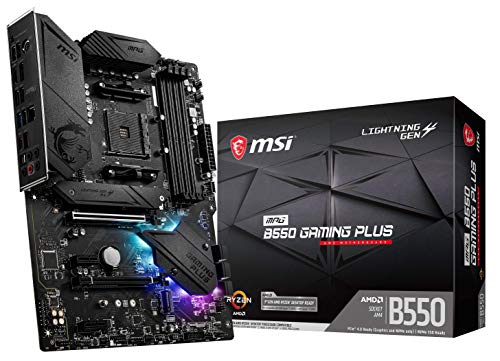
The MSI MPG B550 Gaming Plus V1 is an ATX motherboard designed for PC gamers and builders who want a feature-rich platform without breaking the bank. It supports AMD Ryzen 5000 series processors on the AM4 socket, making it a solid choice for anyone assembling a mid-range to high-performance gaming rig. With PCIe 4.0, DDR4 memory support, and premium thermal components, this board aims to deliver reliable performance for gaming, streaming, and everyday computing.
This motherboard is especially suited for competitive and casual gamers, streamers, content creators, and gaming setup builders who prioritize PCIe 4.0 speeds for their GPU and NVMe SSD. It also appeals to RGB enthusiasts thanks to Mystic Light support with 16.8 million colors and 29 effects. While it lacks integrated Wi-Fi, it offers plenty of connectivity for wired gaming setups and desktop builds.
In terms of performance, the MPG B550 Gaming Plus V1 supports dual-channel DDR4 memory up to 128GB at speeds up to 4400 MHz. This allows for smooth multitasking and reduced loading times in demanding games. The PCIe 4.0 interface ensures that modern graphics cards and fast SSDs can operate at their full potential, giving you quicker level loads and better overall responsiveness. The board also includes AMD Turbo USB 3.2 Gen 2 ports for fast data transfers to external drives and peripherals.
Build quality is a highlight here. The extended VRM heatsink is paired with a 7W/mk thermal pad, which helps keep voltage regulators cool even during extended gaming sessions or overclocking. The PCB is reinforced with 2oz thickened copper, improving signal integrity and durability. Two M.2 slots come with Shield Frozr heatsinks to keep SSDs from throttling under heavy use. Mystic Light headers allow you to sync RGB lighting with compatible fans, strips, and other peripherals.
Setting up this motherboard is straightforward for anyone familiar with ATX builds. The AM4 socket is compatible with a wide range of coolers, though you may need to install a BIOS update for Ryzen 5000 processors (the board supports BIOS flashback if available? - Note: This model does not have USB BIOS Flashback, so an older CPU may be needed to update BIOS). Cable management is facilitated by the standard ATX layout and clear labeling. Maintenance involves occasional dusting of the heatsinks and ensuring good airflow in your case.
One limitation is the lack of built-in Wi-Fi or Bluetooth, so you'll need a separate adapter for wireless connectivity. The board also has only two M.2 slots, which may be limiting for users who want multiple high-speed SSDs. Additionally, out-of-the-box compatibility with Ryzen 5000 may require a BIOS update, which could be a hurdle if you don't have an older AM4 CPU on hand. Despite these points, the MSI MPG B550 Gaming Plus V1 is a strong choice for PC gamers who want PCIe 4.0, good thermal performance, and RGB customization without paying a premium. It works well for gaming PCs, streaming setups, and even productive workstations where wired networking is fine.

Pros
- Excellent power delivery for Ryzen 7000/8000/9000 CPUs, supporting overclocking.
- Comprehensive connectivity: Wi-Fi 6E, Bluetooth 5.3, 2.5G LAN, USB 3.2 Gen 2x2 Type-C.
- Two PCIe 5.0 lanes (one for GPU, one for M.2) for top-tier performance.
- Affordable price point for an X670E board with these features.
- User-friendly BIOS and MSI Center software for easy tuning and monitoring.
Cons
- Limited PCIe 5.0 x16 slot count (only one full-speed slot) may disappoint multi-GPU users.
- Rear I/O lacks USB4 or Thunderbolt support, which some creators might want.
- No built-in POST code display or clear CMOS button on the rear, making troubleshooting less convenient.
The MSI X670E GAMING PLUS WIFI is an ATX motherboard built around the AMD X670E chipset, designed for PC gamers, streamers, esports players, and gaming setup builders who want a solid foundation for their AM5 Ryzen 7000/8000/9000 series build. It balances strong performance with a reasonable price tag, making it a practical choice for those who need DDR5 support, PCIe 5.0 connectivity, and modern wireless standards without paying a premium for flagship extras.
When it comes to gaming performance, the board's 14+2+1 Duet Rail power system with 80A Smart Power Stage delivers clean, stable power to the CPU, even under heavy loads from competitive shooters or open-world titles. The Memory Boost technology supports DDR5 speeds up to 7800MHz+ (overclocked), which means faster data access and snappier load times in games and creative applications. The single PCIe 5.0 x16 slot (with Steel Armor reinforcement) and the Lightning Gen5 M.2 slot give you direct access to the fastest graphics cards and SSDs available, ensuring your rig stays relevant for years.
Connectivity is a strong suit here. You get Wi-Fi 6E and Bluetooth 5.3 built right in, so you can game wirelessly with low latency or easily pair your favorite peripherals. The 2.5G LAN port provides a wired connection that handles large downloads and online multiplayer with ease. On the rear I/O, you'll find USB 3.2 Gen 2x2 Type-C (20Gbps), multiple USB 3.2 Gen 2 ports, and HDMI/DP outputs for integrated graphics, which is handy for troubleshooting or a secondary display.
Cooling is well thought out. The extended VRM heatsink uses 7W/mK thermal pads to keep the power stages from throttling during long sessions, and the M.2 Shield Frozr prevents SSDs from hitting thermal limits. There's also a dedicated pump-fan header and plenty of system fan headers for custom airflow setups. Build quality feels solid with a 6-layer PCB and thickened copper that helps with heat dissipation and signal integrity.
Setup is straightforward for anyone familiar with modern motherboards. The BIOS layout is clean and easy to navigate, with EXPO profiles readily available for one-click memory overclocking. MSI Center software gives you system monitoring, RGB control, and driver updates from one interface. One minor limitation is the lack of USB4 or Thunderbolt on the rear I/O, which might be a drawback if you need very high-speed external storage or multiple high-resolution displays. Also, there is no onboard power/reset button or POST code display, so troubleshooting may require a bit more effort without a speaker or debug card.
Overall, the MSI X670E GAMING PLUS WIFI is a strong recommendation for PC gamers and streamers who want a reliable, well-featured AM5 motherboard without breaking the bank. It works well in competitive esports setups, casual gaming rigs, and workstation builds that need PCIe 5.0 and DDR5. If you're building a new gaming PC and don't need top-end overclocking features or Thunderbolt, this board offers excellent value and performance.
The MSI X670E GAMING PLUS WIFI is built to handle the demands of modern gaming. The 14+2+1 phase power design with 80A Smart Power Stages ensures that even a Ryzen 9 7950X or 7900X can run at full boost during intensive gaming sessions. With Memory Boost, DDR5 kits can reach speeds up to 7800MHz+ (overclocked), reducing latency and improving frame times in CPU-bound titles like esports shooters or simulation games.
The PCIe 5.0 x16 slot provides full bandwidth for current and next-gen graphics cards, while the Gen5 M.2 slot eliminates storage bottlenecks, allowing games to load near-instantly. The board's 2.5G LAN and Wi-Fi 6E keep online gaming responsive, and the Audio Boost 8-channel HD audio delivers clear spatial audio for competitive edge and immersive single-player experiences. Overall, this motherboard gives gamers a solid platform for high-fps gaming without unnecessary extras.
MSI designed the X670E GAMING PLUS WIFI with durability and thermal management in mind. The extended heatsink on the VRM area uses 7W/mK thermal pads to efficiently draw heat away from the power stages, keeping temperatures in check even under prolonged loads. The 6-layer PCB with 2oz thickened copper not only improves heat dissipation but also enhances signal integrity for memory and PCIe lanes.
The M.2 Shield Frozr is a practical touch that prevents NVMe SSDs from throttling due to heat. The board also includes plenty of fan headers, a dedicated pump-fan header, and support for MSI's software-based fan control. Builders will appreciate the Steel Armor reinforcing the primary PCIe slot, which adds physical strength to support heavy graphics cards. The overall layout is clean, with well-placed connectors that make cable management easier in most ATX cases.
Frequently Asked Questions
Do I need WiFi built into my gaming motherboard?
Not always, but it’s a real convenience. Boards like the ASUS TUF Gaming A520M-PLUS (WiFi) and the MSI B760 Gaming Plus WiFi include 802.11ac or WiFi 6E, which saves you from buying a separate adapter. If your PC sits near your router and you can run an Ethernet cable, onboard WiFi is less critical. But for dorm rooms or living room setups where a wired connection isn’t practical, built-in wireless with Bluetooth 5.3 support makes pairing controllers and headsets much easier.
What’s the difference between DDR4 and DDR5 motherboards for gaming?
DDR5 boards like the MSI MAG B760 Tomahawk WiFi support faster memory speeds, up to 7000+ MHz (OC), which can help with CPU-bound scenarios and productivity tasks. DDR4 boards like the Asus ROG Strix B550-F Gaming WiFi II still deliver excellent gaming performance and cost less for both the board and the RAM itself. For most gamers on a budget, DDR4 remains a smart choice. If you’re building a new Intel or AM5 platform and want longevity, DDR5 gives you a longer upgrade runway.
Can a budget motherboard handle a high-end GPU without bottlenecking?
Yes, in most cases. Even an affordable board like the MSI A520M-A PRO has a PCIe x16 slot that can run modern GPUs. The motherboard itself rarely bottlenecks graphics performance. What matters more is CPU pairing, RAM speed, and power delivery stability. Just make sure your case has enough clearance for the GPU and that your PSU provides adequate wattage. Budget boards may lack PCIe 4.0, which slightly affects NVMe SSD speeds but has minimal impact on GPU throughput for gaming.
Is PCIe 5.0 worth it on a gaming motherboard right now?
For most gamers in 2026, PCIe 5.0 is more about future-proofing than immediate gains. Boards like the MSI X670E Gaming Plus WiFi and the MSI MAG B760 Tomahawk WiFi offer PCIe 5.0 slots, but current GPUs and most SSDs still run on PCIe 4.0. The real benefit comes if you plan to keep your board for several years and want compatibility with next-gen storage. It’s a nice-to-have, not a must-have, unless you’re building with a long upgrade path in mind.
How important is VRM cooling on a gaming motherboard?
VRM heatsink quality directly affects how well your board handles sustained CPU loads. Boards like the Asus ROG Strix B550-F Gaming WiFi II with 12+2 teamed power stages and ProCool connectors keep voltage regulators cool under heavy gaming or streaming workloads. Poor VRM cooling can lead to thermal throttling, which quietly drops your CPU clocks and hurts frame rates. If you’re pairing a Ryzen 7 or an Intel Core i7 with your board, solid power delivery matters. You can also check out whether the AMD Ryzen 7 7700 is good for gaming to see how CPU and board pairing works together.
Should I buy a legacy LGA 1155 motherboard for a budget gaming build?
Boards like the SHANGZHAOYUAN LGA 1155 Motherboard H61C can work for ultra-budget builds using older Intel 2nd or 3rd gen processors. They support DDR3 memory up to 16GB and include an M.2 slot (PCIe 2.0 x4 for NVMe). But these platforms have significant limitations: 100Mbps LAN, no WiFi, and older USB standards. For light esports titles at lower settings, it can get the job done. Just be aware that driver support, BIOS updates, and long-term reliability from lesser-known brands require more patience and troubleshooting compared to mainstream options from ASUS or MSI.
What features should I prioritize when picking a gaming motherboard in 2026?
Focus on socket compatibility first, then look at M.2 NVMe slot count, VRM quality, and network connectivity. A board with at least one Gen 4 M.2 slot keeps load times fast. USB 3.2 Gen 2 ports help with external drives and capture cards. If you’re into RGB customization, boards with Aura Sync or Mystic Light headers let you unify your lighting. Also check for a BIOS Flashback button, which boards like the best air-cooled gaming PCs often rely on for hassle-free CPU updates without needing an older chip installed.




Write Your Review
No reviews yet. Be the first to share your experience!