


Balancing expansive screen real estate with sharp visuals often leaves PC gamers debating whether a 32-inch panel retains adequate pixel clarity at 2560 x 1440 resolution. Stepping up from smaller screens or older 1440p 60Hz gaming monitor setups provides a far more immersive field of view, yet it requires solid graphics hardware to sustain fluid motion. Identifying the best gaming monitor 32 1440p setup means weighing panel technology, curve radii like 1000R versus 1500R, and rapid refresh rates up to 240Hz against your everyday gaming needs. By analyzing published manufacturer specifications, panel capabilities, and user feedback, this guide breaks down top displays from Samsung, SANSUI, LG and more to help you select the right balance of speed and clarity.
Display responsiveness remains critical, especially when comparing Fast IPS panels against high-contrast VA alternatives that emphasize deeper black levels in dark scenes. Many players upgrading from compact 27-inch 144Hz monitor screens will appreciate the added immersion of curved form factors without sacrificing variable refresh rate performance. Features like AMD FreeSync, NVIDIA G-Sync compatibility, and low motion blur modes ensure frames stay tear-free during chaotic matches. We examine verified manufacturer features, ergonomic adjustments, and port options across every featured model so you can upgrade your battlestation with confidence.

Pros
- High 180Hz refresh rate and 0.5ms response time for competitive edge.
- Curved 1500R design enhances immersion without taking up too much desk space.
- Shadow Boost improves visibility in dark game scenes.
- FreeSync support ensures smooth, tear-free gameplay with compatible GPUs.
- Solid build quality with a 3-year warranty for peace of mind.
Cons
- Limited to 2560x1440 resolution; not 4K for those wanting higher pixel density.
- Stand adjustments may be basic; some users may prefer a more ergonomic stand.
- Speakers not included; external audio needed for sound.
The ASUS TUF Gaming VG32WQ3B is a 31.5-inch QHD curved gaming monitor designed for PC gamers who want a balance of size, speed, and visual quality. With a 2560x1440 resolution, 180Hz refresh rate, and 0.5ms response time, this monitor is built to handle fast-paced competitive titles like first-person shooters and MOBAs, while also delivering immersive visuals for open-world adventures. The 1500R curvature wraps around your peripheral vision, making it a great fit for gaming setups where immersion matters.
This monitor is best suited for competitive gamers, esports players, and casual gamers who prioritize smooth motion and quick response. Streamers and content creators will also appreciate the 90% DCI-P3 color coverage, which provides vibrant and accurate colors for editing or streaming. The FreeSync support ensures tear-free gameplay when paired with compatible AMD or NVIDIA GPUs, making it a versatile choice for a wide range of PC builds.
In terms of real-world performance, the 180Hz refresh rate and 0.5ms response time deliver exceptionally fluid motion with minimal input lag. The ASUS Extreme Low Motion Blur (ELMB) technology further reduces ghosting, keeping fast-moving objects sharp during intense firefights. Shadow Boost is a practical feature that brightens dark areas without washing out highlights, helping you spot enemies hiding in shadows. The QHD resolution offers a nice sweet spot between clarity and performance, allowing high frame rates even on mid-range graphics cards.
Build quality is solid, with a sturdy stand and a sleek black design that fits into most gaming setups. The monitor includes a DisplayPort cable, an L-shaped screwdriver for easy assembly, and a power cord. Setup is straightforward: attach the stand, plug in the cables, and you're ready to go. The on-screen display (OSD) is intuitive, and the DisplayWidget software lets you adjust settings like brightness, contrast, and Shadow Boost using your mouse, which is a nice convenience for those who prefer not to reach for buttons.
One realistic limitation is the lack of built-in speakers, so you'll need external speakers or a headset for audio. The stand offers tilt adjustment but may not provide full ergonomic flexibility like height or swivel adjustments found on some competitors. Additionally, while QHD is great for gaming, users seeking 4K resolution for productivity or content creation may want to look elsewhere. The monitor's 31.5-inch size is large but manageable on most desks, though it may require a bit of space for optimal viewing distance.
Overall, the ASUS TUF Gaming VG32WQ3B is a strong recommendation for PC gamers who want a large, curved QHD monitor with high refresh rates and low response times. It's particularly well-suited for competitive gamers who need every millisecond advantage, as well as casual gamers who want an immersive experience without breaking the bank. With its 3-year warranty and solid feature set, it offers good long-term value for gaming setups, dorm rooms, or home offices where gaming and productivity blend.

Pros
- Sharp QHD resolution paired with high 180Hz refresh rate for an excellent gaming experience.
- IPS panel ensures vibrant colors and wide viewing angles for both gaming and productivity.
- G-Sync and FreeSync compatibility cover both NVIDIA and AMD GPUs without screen tearing.
- Adjustable stand with ergonomic flexibility for comfortable long sessions.
- HDR10 adds extra depth and realism to compatible games and media.
Cons
- HDR performance is limited compared to higher-end monitors with better peak brightness.
- No built-in speakers, so external audio is required for sound.
- Stand base may take up desk space; VESA mount optional for more flexibility.
The Samsung 32” Odyssey G5 G50F is a mid-range gaming monitor that strikes a solid balance between performance and price. With a QHD resolution (2560x1440) and a fast IPS panel, it delivers crisp visuals and wide viewing angles that work well for both immersive open-world games and competitive titles. The 180Hz refresh rate and 1ms GtG response time ensure buttery-smooth motion and almost zero ghosting, making it a strong choice for fast-paced genres like FPS and racing games.
This monitor is best suited for PC gamers who want a step up from standard 1080p without jumping to 4K. It's also a good fit for esports players who value high refresh rates, and for streamers or content creators who need color-accurate IPS performance for editing. G-Sync and FreeSync compatibility mean tearing and stuttering are effectively eliminated, whether you're using an NVIDIA or AMD graphics card. The inclusion of HDR10 adds some extra punch in compatible titles, though peak brightness is moderate.
Build quality is solid, with a sturdy ergonomic stand that offers height, tilt, swivel, and pivot adjustments. This makes it easy to find a comfortable viewing angle for long gaming sessions or desk work. The Auto Source Switch+ feature is a nice convenience for users with multiple devices like a PC and console, automatically detecting the active input. The monitor also includes a Black Equalizer to brighten dark areas without washing out colors, and a Virtual Aim Point to help with crosshair placement.
Setup is straightforward: the stand attaches to the panel with included screws, and the monitor connects via DisplayPort or HDMI. The on-screen display (OSD) is intuitive, with a joystick for navigation. Cable management is minimal because the stand has a clip to route cables neatly. One limitation to consider is the lack of built-in speakers, so you'll need separate speakers or a headset for audio. Additionally, while HDR10 is supported, it's not at the same level as high-end HDR monitors with better local dimming.
For desk organization, the stand footprint is moderate, but if you're tight on space, the monitor supports VESA mounting (100x100mm) to free up the desk. The matte screen finish helps reduce glare in lit rooms. Overall, this is a versatile monitor that handles gaming, streaming, and everyday tasks well. It's a recommended buy for gamers looking to upgrade to a larger QHD display with a high refresh rate without breaking the bank. For casual players, competitive gamers, and setup builders alike, the Odyssey G5 G50F offers reliable performance and solid ergonomics.

Pros
- Excellent image quality with QHD resolution and HDR10 for vivid colors and sharp details
- High 165Hz refresh rate and 1ms response time make it ideal for competitive gaming
- 1000R curvature provides deep immersion without distorting the image
- FreeSync compatibility ensures smooth gameplay with compatible AMD GPUs
- Eye care features help reduce fatigue during long gaming sessions
Cons
- Stand offers only tilt adjustment, limiting ergonomic flexibility
- No built-in speakers, so external audio is required
- Requires DisplayPort connection to achieve full 165Hz refresh rate (HDMI limited to 144Hz)
The Samsung 32" Odyssey G55C is a QHD curved gaming monitor designed for PC gamers who want a balance of resolution, speed, and immersion. With a 2560x1440 resolution and a 1000R curvature, it aims to deliver a wrap-around viewing experience that pulls you into the game. The 165Hz refresh rate and 1ms MPRT response time make it a strong contender for both casual and competitive play.
This monitor is best suited for gamers who play a mix of fast-paced shooters, open-world adventures, and esports titles. Streamers and content creators will appreciate the extra screen real estate for multitasking, while casual gamers will enjoy the smooth visuals and vibrant HDR10 support. The QHD resolution also offers a nice middle ground between 1080p and 4K, providing sharp details without demanding as much GPU power.
In terms of performance, the 165Hz refresh rate ensures that motion stays fluid whether you're flicking in Valorant or exploring in Cyberpunk 2077. The 1ms response time keeps ghosting to a minimum, which is crucial for competitive gaming. AMD FreeSync helps eliminate screen tearing when paired with a compatible graphics card, making gameplay feel seamless. The 1000R curve is quite aggressive, but it works well for a 32-inch panel, filling your peripheral vision and reducing eye movement during long sessions.
Build quality is solid with a sleek black design and a relatively slim profile. The stand is functional but basic, offering only tilt adjustment. If you need height or swivel adjustments, you may want to consider a VESA mount (100x100mm compatible). The on-screen display (OSD) is easy to navigate via a joystick, and the monitor includes both DisplayPort and HDMI inputs. There are no USB ports or built-in speakers, so plan your cable management and audio setup accordingly.
Setting up the Odyssey G55C is straightforward: unbox, attach the stand, and connect your PC. For the best performance, use the included DisplayPort cable to hit 165Hz. The monitor also features Eye Saver Mode and flicker-free technology, which can help reduce eye strain during those late-night gaming marathons. The anti-glare coating is effective in bright rooms, keeping reflections to a minimum.
Some realistic limitations include the lack of ergonomic stand adjustments and the absence of built-in speakers. Also, the 1000R curve may not appeal to everyone, especially if you use the monitor for productivity tasks like spreadsheets or design work, as straight lines may appear slightly bent. Overall, the Samsung Odyssey G55C is a strong choice for gamers who prioritize immersion and smooth performance. It's a practical upgrade for anyone building a dedicated gaming setup or looking to move beyond 1080p without breaking the bank.
The 165Hz refresh rate and 1ms MPRT response time make the Odyssey G55C a responsive monitor for fast-paced gaming. In first-person shooters like Call of Duty or Overwatch, the high refresh rate reduces motion blur and gives you a competitive edge by displaying frames more quickly. The 1ms response time helps keep fast-moving objects sharp, minimizing ghosting during intense firefights.
AMD FreeSync support ensures that the monitor's refresh rate syncs with your GPU, eliminating screen tearing and stuttering. This is particularly beneficial in games where frame rates fluctuate, such as open-world titles or battle royales. The QHD resolution strikes a good balance between visual fidelity and performance, allowing you to run modern games at high settings without needing a flagship graphics card.
The 1000R curve enhances immersion in racing games and flight simulators, where the wrap-around effect makes you feel more inside the cockpit. In RPGs like The Witcher 3 or Elden Ring, the curved screen helps draw you into the world, though it may take a short adjustment period if you're used to flat panels. Overall, the G55C delivers a smooth, responsive gaming experience that suits a wide range of genres.

Pros
- High 180Hz refresh rate combined with 1ms response ensures exceptional motion clarity and responsiveness
- 1000R curve enhances immersion, especially in single-player story-rich games and simulators
- Great color accuracy at this price point with 99% sRGB and HDR10 support
- Useful gaming features like crosshair overlay and FPS counter give a competitive edge without external software
Cons
- Stand only offers tilt adjustment - no height or swivel may limit ergonomic setup for some users
- QHD 180Hz requires a powerful graphics card to fully utilize, especially in demanding titles
- No built-in speakers and no USB hub - may require additional peripherals for a complete desk setup
The LG 32GS60QC-B Ultragear is a 32-inch QHD curved gaming monitor that blends high-speed performance with immersive visual design. Aimed squarely at PC gamers, competitive players, esports competitors, and streamers who demand fluid motion and vivid colors, this monitor delivers a 180Hz refresh rate and 1ms GtG response time. Whether you are fragging in Overwatch, drifting in Forza, or exploring open worlds in Elden Ring, the combination of speed and resolution ensures every frame is sharp and responsive.
At the heart of this monitor is a steep 1000R curve that wraps around your field of view, making long gaming sessions feel more absorbing. The QHD (2560x1440) resolution hits a sweet spot between sharpness and performance, offering a noticeable step up from 1080p without the heavy GPU demands of 4K. AMD FreeSync support keeps tearing and stuttering at bay, which is a major plus for anyone running an AMD GPU or even a compatible NVIDIA card.
Build quality is solid with a virtually borderless design that keeps the focus on the screen. The stand is functional but basic - it only tilts, so you may want to consider a VESA mount if you need height or swivel adjustments. Connectivity is straightforward with two HDMI 2.0 ports and one DisplayPort 1.4, letting you hook up a gaming PC, a console, and maybe a streaming laptop simultaneously. The on-screen menu includes useful tools like Black Stabilizer for dark scenes, Dynamic Action Sync for lower input lag, and an FPS counter so you can monitor performance without third-party overlays.
Color performance is quite strong for a monitor in this price range, hitting up to 99% sRGB coverage and supporting HDR10. While HDR peak brightness is modest, the wider color gamut makes games pop with richer tones. For content creators doing light photo or video work, the accurate colors are a nice bonus. The 1000R curve also helps reduce eye strain during long editing sessions by keeping the entire screen at a consistent focal distance.
Setting up the monitor is plug-and-play: just connect the included DisplayPort or HDMI cable, adjust the tilt to your preferred angle, and you are ready to game. No complicated software is needed, though you can tweak settings via the joystick-controlled OSD. One realistic limitation is that the stand takes up a decent amount of desk depth due to the curve, so measure your space if you have a shallow desk. Also, there are no built-in speakers, so you will need a headset or external speakers for audio.
For the asking price, the LG 32GS60QC-B offers excellent value for PC gamers who want a large curved QHD display with competitive-level speed. It suits competitive gamers upgrading from a 1080p 144Hz monitor, casual players wanting more immersion, and streaming setup builders needing a clean, fast main display. If you can live with the limited stand adjustment and bring your own GPU horsepower, this monitor is a strong buy for any gaming-focused desk.
Pros
- High refresh rate and fast response time for competitive gaming.
- WQHD resolution offers a sharp, detailed picture without needing a top-tier GPU.
- Wide color gamut enhances visual quality in games and media.
- Multiple input options and included DP cable simplify connectivity.
- VESA mount compatibility allows for custom mounting solutions.
Cons
- Built-in speakers are not included, so external audio is required.
- Stand only offers tilt adjustment, lacking height and swivel options.
- 300 nits brightness may be insufficient for very bright rooms.
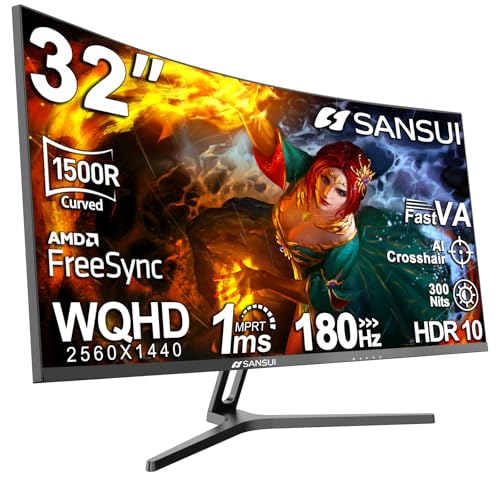
The SANSUI 32-inch curved gaming monitor is a versatile display designed for PC gamers who want a balance of performance and value. With its WQHD resolution and 180Hz refresh rate, it caters to both competitive players seeking smooth motion and casual gamers who appreciate detailed visuals. The 1500R curvature wraps around your field of view, making it a great fit for immersive single-player titles and fast-paced esports games alike.
In terms of real-world performance, the 180Hz refresh rate and 1ms response time ensure that fast movements remain clear and responsive. This is especially beneficial for FPS and racing games where every millisecond counts. The VA panel delivers deep blacks and good contrast, while the sRGB 125% and DCI-P3 95% color coverage makes colors pop, enhancing both gaming and content consumption. AMD FreeSync support helps eliminate screen tearing, providing a smoother experience when paired with compatible graphics cards.
Build quality is solid for its price range, with a sturdy stand that offers tilt adjustment. The monitor is VESA compatible, allowing you to mount it on an arm or wall for a cleaner desk setup. Connectivity is generous with two HDMI ports and two DisplayPort inputs, plus a DP cable included in the box. However, note that there are no built-in speakers, so you will need external speakers or a headset for audio.
Setting up the monitor is straightforward, and the on-screen display menu is easy to navigate. The lack of height and swivel adjustments on the stand may be a limitation for some users, but the tilt function and VESA compatibility offer flexibility. The 300 nits brightness is adequate for most indoor environments, though very bright rooms might require some shading.
Overall, the SANSUI 32-inch curved gaming monitor is a practical choice for PC gamers, streamers, and content creators who want a large, high-refresh-rate display without a premium price tag. It works well for competitive gaming, casual play, and even productivity tasks thanks to the extra screen real estate. If you can work around the lack of speakers and limited stand adjustments, this monitor delivers strong performance and visual quality for its cost.

Pros
- High 180Hz refresh rate and 0.5ms MPRT for competitive gaming smoothness.
- QHD resolution on a 32-inch curved display offers sharp details and immersive field of view.
- Excellent console compatibility with HDMI 2.0 supporting up to 120Hz.
- Included 3-year zero-dead-pixel warranty and 1-year accidental damage coverage offer peace of mind.
- Low input lag and adaptive sync readiness for tear-free gameplay (though not explicitly G-Sync/FreeSync, user reports suggest compatibility).
Cons
- VA panel may have limited viewing angles compared to IPS, though curves help with center viewing.
- Stand likely offers only tilt adjustment (based on typical budget monitors), may require VESA mount for full ergonomics.
- No built-in speakers (common for gaming monitors) – external audio needed.
The AOC CQ32G4VE is a 32-inch curved QHD gaming monitor that strikes a great balance between immersive size and high-performance specs. Built around a VA panel with 2560x1440 resolution and a 1500R curvature, it’s designed to wrap your field of view for games like racing sims, open-world RPGs, and competitive shooters. With a 180Hz refresh rate and 0.5ms MPRT response time, this monitor targets PC gamers who want smooth motion without breaking the bank.
Who should consider the CQ32G4VE? It’s ideal for competitive gamers who need high refresh rates for fast-paced FPS and MOBA titles, but also works well for casual gamers who enjoy immersive single-player experiences. Streamers and content creators will appreciate the extra screen real estate for multitasking, and console gamers can take advantage of the HDMI 2.0 ports to run games at up to 120Hz. Even college gamers or work-from-home setup builders will find this monitor a versatile addition for both productivity and play.
Performance-wise, the 180Hz refresh rate and quick response make a noticeable difference in responsive gameplay. You’ll see less motion blur in fast scene transitions, and the low input lag keeps your actions feeling instant. The QHD resolution provides a sharp, detailed image without demanding as much GPU power as 4K, making it a sweet spot for mid-range gaming PCs. The VA panel’s high contrast ratio (80,000,000:1 SmartContrast) delivers deep blacks and vibrant colors, which adds pop to HDR content, though peak brightness is more moderate.
Build quality is solid for a budget-tier monitor. The thin bezels give a modern look and work well for multi-monitor setups. The stand provides tilt adjustment but lacks height, swivel, or pivot – if you need ergonomic flexibility, you can mount it via the VESA 100x100 pattern. Connectivity is generous with two DisplayPort 1.4 and two HDMI 2.0 ports, plus a headphone jack. Setting up is straightforward: plug in, adjust OSD settings for your preferred brightness and contrast, and you’re ready to game. The on-screen display is easy to navigate with dedicated buttons.
One realistic limitation is that VA panels typically have narrower viewing angles than IPS, so colors shift if you’re not centered. However, for a single-user setup the curve helps maintain consistency. There are no built-in speakers, so you’ll need external speakers or a headset for audio. The stand’s limited ergonomics might be a downside if you’re particular about desk positioning, but the affordable price leaves room for a monitor arm upgrade. Also, while the monitor supports FreeSync (based on typical AOC specs), competitive gamers should confirm compatibility with their GPU for adaptive sync.
Ultimately, the AOC CQ32G4VE is a fantastic value for gamers who want a large curved QHD display with high refresh rates. It’s particularly well-suited for PC and console gamers who prioritize smooth motion and immersion in their game library. Combined with the strong warranty (3-year zero-bright-dot, 3-year advance replacement, and 1-year accidental damage), it’s a low-risk investment for any gaming setup. If you’re building a mid-range gaming rig or upgrading your console station, this monitor delivers where it counts without unnecessary frills.

Pros
- High 240Hz refresh rate and 1ms response time ideal for esports and fast-paced shooters
- 1000R curvature matches natural eye shape for reduced eye strain during long sessions
- QHD resolution offers a great balance of sharpness and performance without demanding too much GPU power
- Adaptive Sync works with both AMD and NVIDIA GPUs for smooth, tear-free visuals
Cons
- Stand only offers tilt adjustment, no height or swivel options, which may require an aftermarket monitor arm for ergonomic setups
- Limited to 240Hz over DisplayPort; HDMI ports may cap at lower refresh rates depending on version
- Built-in speakers are often basic on gaming monitors; external speakers or headset recommended for better audio
The KTC H32S25E is a 32-inch curved gaming monitor built for PC gamers who want high refresh rates and immersive visuals without breaking the bank. With a 240Hz refresh rate, 1ms response time, and 2560x1440 resolution, this monitor targets competitive players in FPS and MOBA titles, as well as casual gamers who enjoy rich, expansive worlds. The 1000R curvature wraps around your peripheral vision, making it feel like you are inside the action rather than just watching it.
For competitive gamers and esports enthusiasts, the 240Hz panel and Adaptive Sync support are key. They work together to minimize motion blur and screen tearing, giving you a clearer view of fast-moving targets. The 1ms response time helps your inputs feel instant, which is crucial in games like Valorant, Apex Legends, or Call of Duty. The QHD resolution also provides enough detail to spot enemies at distance while keeping GPU demands lower than 4K, so you can maintain high frame rates with a mid-range graphics card.
Build quality is solid for a monitor in this price range. The frameless design looks modern on any desk, and the tilt adjustment lets you angle the screen for comfort. However, the stand lacks height and swivel adjustments, so you may want to pair it with a VESA-compatible monitor arm for better ergonomics. The monitor is fairly heavy at 19.25 pounds, so a sturdy desk or mount is recommended.
Connectivity is a strong point: two HDMI ports and two DisplayPort inputs let you hook up multiple devices like a gaming PC, console, and streaming box simultaneously. The DisplayPort supports the full 240Hz, while HDMI may be limited to lower refresh rates depending on the version. This makes the monitor versatile for both PC gaming and console use, though console players will be capped at 120Hz on most current systems.
Setup is straightforward: the monitor comes partially assembled, and you just attach the stand and plug in cables. The on-screen display (OSD) is controlled via buttons on the back, which can be a bit fiddly but gets the job done. The monitor includes basic HDR support, which enhances contrast in supported games and media, though it is not HDR1000 level. For the price, the color accuracy and 122% sRGB coverage are very good for gaming and even light creative work.
Overall, the KTC H32S25E is a great fit for PC gamers who want a large, curved, high-refresh monitor for competitive play and immersive single-player experiences. It works well for streamers who need a smooth secondary display, and for work-from-home setups where screen real estate matters. The lack of height adjustment and basic HDR are minor drawbacks, but the core gaming performance and value make it a strong recommendation for U.S. gamers building a performance-focused setup.
The KTC H32S25E delivers a smooth and responsive gaming experience thanks to its 240Hz refresh rate and 1ms response time. In fast-paced shooters like Overwatch 2 and Rainbow Six Siege, the high refresh rate reduces motion blur and makes tracking targets feel fluid. Adaptive Sync (compatible with both FreeSync and G-Sync) eliminates screen tearing without adding input lag, which is essential for competitive play. The QHD resolution provides a sharp image without overloading your GPU, allowing high frame rates in most modern titles. The 1000R curvature enhances peripheral awareness, making it easier to spot enemies at the edges of the screen during intense firefights.
This monitor uses a VA panel with a 4000:1 contrast ratio, delivering deep blacks and good shadow detail in dark game scenes. The 122% sRGB coverage ensures vibrant colors in games and media, though out-of-the-box calibration may need minor tweaks for color-critical work. HDR support adds some extra pop in compatible content, but peak brightness is moderate, so it won't rival high-end HDR monitors. For everyday gaming and streaming, the picture quality is very satisfying, especially with the immersive curvature that pulls you into the game world.
The KTC H32S25E offers two HDMI 2.0 ports and two DisplayPort 1.4 inputs, giving you flexibility to connect multiple devices. The DisplayPort supports the full 240Hz at 1440p, while HDMI is limited to 144Hz at 1440p (depending on the source). This makes it ideal for a multi-platform setup with a PC and a console, or for streamers who want to connect a capture card. The monitor also includes a 3.5mm headphone jack for audio output. Cable management is basic, but the ports are positioned conveniently on the back for easy access.
The monitor features a sturdy plastic build with a matte black finish and a thin bezel that gives it a modern, almost frameless look. The stand is stable but only offers tilt adjustment (-5 to +20 degrees). If you need height or swivel, you will need a VESA mount (100x100mm). The monitor weighs about 19.25 pounds, so it feels solid on a desk. The on-screen display buttons are on the back and work reliably, though they can be a bit stiff. Overall, the build quality is good for the price point and should hold up well over years of use.
Frequently Asked Questions
Is a 32-inch 1440p display sharp enough for gaming and daily PC work?
Yes, a 32-inch QHD screen delivers approximately 93 pixels per inch, which provides solid visual clarity and substantial desktop screen space. It offers sharper detail than a standard 1080p panel of similar dimensions while placing less strain on your graphics card than a 4K panel.
What is the difference between a 1000R and a 1500R curved gaming monitor?
The number indicates the curve radius in millimeters, meaning a 1000R curve is noticeably tighter and more aggressive than a gentle 1500R curve. Displays with a 1000R arc wrap more closely around your peripheral field of view, while 1500R options provide subtle curvature that feels natural for both gaming and general productivity.
Can these 32-inch 1440p monitors work well with gaming consoles?
Yes, models such as the AOC CQ32G4VE specifically note console compatibility supporting up to 120Hz refresh rates over HDMI. Players looking for dedicated console displays can also explore our guide to the best console monitor under 300 for further setup alternatives. Note that console output depends on individual console resolution and refresh rate support.
Should I choose an IPS or VA panel for a 32-inch 1440p gaming monitor?
Your choice depends on whether you prioritize viewing angles or deep black levels. The Samsung Odyssey G50F features a Fast IPS panel with wide 178-degree viewing angles and fast gray-to-gray transitions, whereas VA models from KTC and AOC deliver higher native contrast ratios that excel in dimmer rooms.
What refresh rate should I target when choosing the best gaming monitor 32 1440p in 2026?
Most current displays in this class feature 165Hz to 180Hz panels, with high-speed models reaching 240Hz for competitive action. Upgrading beyond traditional 144Hz gaming monitors ensures noticeably smoother motion when paired with variable refresh rate technologies like AMD FreeSync or NVIDIA G-Sync.







Write Your Review
No reviews yet. Be the first to share your experience!