


Choosing a display often comes down to balancing screen real estate with specific performance needs. Many users struggle with finding the right balance between motion clarity and text sharpness for long sessions. Top Rated Monitor Brands can help narrow down the field by focusing on established manufacturers that prioritize reliability. Brands like Philips, Sceptre, and Acer offer distinct advantages depending on whether you need a compact office monitor or a large gaming panel. The variety in panel types, from TN to VA, means there is no single best choice for everyone. You need to look at the specific specs that matter for your daily tasks.
Based on product specifications and user feedback, these brands provide solid options across different price points. The best monitor for office work often prioritizes eye comfort and stand adjustability. Conversely, gamers look for high refresh rates and low response times to reduce motion blur. Philips stands out with its VA panels that offer deep blacks and wide viewing angles. Sceptre provides value with curved options that enhance immersion without breaking the bank. By analyzing the port selection and refresh rate capabilities, you can avoid common pitfalls like screen tearing. This approach ensures you pick a display that fits your desk and your budget.


Pros
- Affordable price point for a 100Hz VA monitor with good contrast
- Frameless design looks modern and works great in multi-monitor arrays
- Eye care features are genuinely helpful for long sessions
- VESA compatibility adds flexibility for desk organization
- 4-year advance replacement warranty provides peace of mind
Cons
- Only 100Hz, not ideal for competitive esports gamers seeking higher refresh rates
- Limited connectivity (1x HDMI, 1x VGA) – no DisplayPort or USB-C
- VA panel may have slight ghosting in fast-paced scenes compared to IPS
The Philips 241V8LB is a 23.8-inch Full HD monitor that bridges the gap between budget-friendly pricing and practical performance for PC gamers and everyday users. It features a VA panel with a 100Hz refresh rate, making it a solid entry-level choice for casual gamers, college students, and work-from-home gamers who want smoother visuals without breaking the bank.
This monitor is best suited for casual PC gamers who play titles like Minecraft, Fortnite, or indie games, as well as for productivity users who need a reliable second screen. The 100Hz refresh rate offers a noticeable upgrade over standard 60Hz displays, reducing motion blur and providing a more fluid experience in games and desktop navigation. However, competitive esports players may want to look for higher refresh rates like 144Hz or 240Hz for peak responsiveness.
In terms of performance, the VA panel delivers excellent contrast – deeper blacks and brighter whites compared to typical IPS panels – which enhances visual clarity in darker game scenes and movies. The 178/178 degree viewing angles ensure consistent colors from most positions, though VA panels can exhibit slight color shift at extreme angles. The monitor also includes Philips' Eye Care technology (flicker-free and low blue light mode) to reduce eye strain during long gaming or work sessions, and an EasyRead mode that mimics paper for reading documents.
Build quality is practical: the monitor has a slim, frameless design on three sides, which not only looks modern but also makes multi-monitor setups seamless. It weighs just over 6 pounds and has a compact footprint, so it won't dominate your desk. The stand is basic but functional, with tilt adjustment. VESA 100x100mm compatibility means you can easily mount it on an arm for better ergonomics and cable management.
Setup is straightforward – plug in the HDMI or VGA cable, and you're good to go. There's no USB hub or built-in speakers, but for the price, that's expected. The on-screen menu is simple to navigate for adjusting brightness, contrast, and eye care settings. Maintenance is minimal; just occasional dusting of the screen.
Realistically, the main limitation is the lack of DisplayPort or USB-C connectivity, which might be a dealbreaker for some modern laptops. Also, while 100Hz is smooth, it's not optimized for high-speed competitive gaming. However, for its price point, the Philips 241V8LB offers excellent value for casual gamers, college gamers, and anyone building a budget-friendly gaming or productivity setup. If you're looking for an affordable monitor that does the job without fuss, this is a strong recommendation.


Pros
- High 100Hz refresh rate delivers smooth motion for casual and competitive gaming.
- VA panel offers excellent contrast ratio for richer colors and deeper blacks compared to typical IPS monitors.
- Adaptive Sync support reduces screen tearing without requiring a high-end GPU.
- LowBlue Mode and flicker-free technology reduce eye fatigue during long sessions.
- Affordable price point makes it accessible for budget-conscious gamers and students.
Cons
- Limited to 22-inch size, which may feel small for immersive gaming or multi-window productivity.
- Only one HDMI port and one VGA port, lacking DisplayPort or USB-C connectivity for modern setups.
- No built-in speakers, requiring external speakers or headphones for audio.
The Philips 221V8LB is a 22-inch Full HD monitor that targets budget-minded PC gamers, casual gamers, and home office users who want a reliable display without spending a lot. With a 100Hz refresh rate and Adaptive Sync, it offers smoother motion than standard 60Hz monitors, which can make a noticeable difference in fast-paced games like shooters or racing titles. The VA panel provides deeper blacks and better contrast than many entry-level IPS monitors, giving you more vibrant visuals for gaming and media.
This monitor is best suited for casual gamers, college gamers, and work-from-home users who need a secondary display or a compact primary monitor for a small desk. Its 22-inch size fits easily into tight spaces, and the VESA mount compatibility allows for flexible desk setups or wall mounting to improve cable management. The 100Hz refresh rate and Adaptive Sync help reduce screen tearing and stuttering, making gameplay feel more fluid without needing a high-end graphics card.
In terms of performance, the 100Hz refresh rate provides a noticeable upgrade over standard 60Hz displays, especially in games where quick reactions matter. The Adaptive Sync technology works with compatible GPUs to keep frames smooth, which is a nice bonus at this price point. The VA panel also offers 178-degree viewing angles, so colors stay consistent even when you're not sitting directly in front of the screen. This can be useful for co-op gaming or when sharing your screen with others.
Build quality is solid for a budget monitor, with a simple black design that won't distract from your gaming setup. The stand is basic but functional, and the VESA mount option gives you the freedom to use an aftermarket arm or mount for a cleaner desk. The inclusion of both HDMI and VGA ports ensures compatibility with older PCs or laptops, though you won't find DisplayPort or USB-C here. This might limit connectivity for some modern devices, but for most casual setups, it's sufficient.
Setting up the Philips 221V8LB is straightforward. It comes with an HDMI cable and a power cord, so you can plug it in and start using it right away. The on-screen menu is easy to navigate, and the LowBlue Mode is a nice touch for reducing eye strain during long gaming sessions or late-night work. However, there are no built-in speakers, so you'll need to rely on external speakers or a gaming headset for audio. This is common for budget monitors, but it's worth noting if you prefer an all-in-one solution.
One realistic limitation is the 22-inch screen size, which may feel cramped for immersive gaming or for users who multitask with multiple windows open. Also, the lack of a DisplayPort or higher refresh rate (like 144Hz) means it's not ideal for competitive esports players who demand the fastest response times. But for its price, the Philips 221V8LB delivers good value for casual gamers, students, or anyone needing a reliable secondary monitor. If you're building a budget gaming PC or setting up a dorm room gaming station, this monitor is a practical choice that won't disappoint.

Pros
- Large 32-inch screen with 100Hz and 1ms response suitable for competitive gaming
- Adaptive-Sync support reduces tearing without needing G-Sync or FreeSync premium
- VESA compatibility allows easy mounting on arms or wall for cleaner cable management
- 4-year advanced replacement warranty stands out among budget monitors
- Affordable price point for a 32-inch gaming monitor with solid specs
Cons
- FHD (1080p) resolution on a 32-inch screen may look less sharp compared to 1440p or 4K alternatives
- VA panel may have slower pixel response in dark transitions compared to high-end IPS panels
- Limited ergonomic adjustments (height, tilt) – basic stand may require VESA mount for optimal positioning
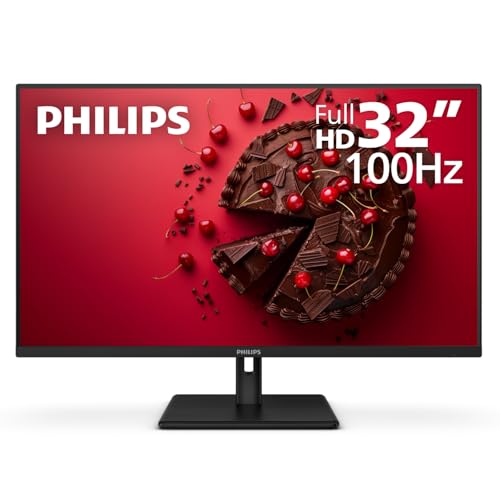
The Philips 32E1N1100L is a 32-inch Full HD gaming monitor built around a VA panel with a 100Hz refresh rate and 1ms response time. It's designed for PC gamers who want a large screen without breaking the bank, and it works well for both competitive and casual play, as well as streaming and daily productivity.
This monitor suits a wide range of users: competitive gamers will appreciate the low-lag 100Hz refresh and Adaptive-Sync, which reduces screen tearing in fast-paced shooters like Valorant or Call of Duty. Casual gamers and those who enjoy open-world titles will benefit from the VA panel's deep contrast and rich colors. Streamers and content creators can use it as a secondary monitor or a primary display for video editing, thanks to its generous 32-inch real estate. Work-from-home gamers and college students will find the FHD resolution adequate for multitasking, though text sharpness may not match higher-resolution panels.
In terms of real-world performance, the 100Hz refresh rate provides noticeably smoother motion than standard 60Hz monitors, and the 1ms response time helps reduce ghosting. Adaptive-Sync works with both AMD FreeSync and NVIDIA G-Sync compatible GPUs, ensuring fluid gameplay without stutter. The VA panel offers good contrast and black levels, making dark scenes in games like Diablo 4 or Resident Evil more immersive. However, some users may notice slight blur in fast-moving dark scenes compared to high-end IPS panels.
Build quality is typical for a budget monitor: the plastic chassis feels sturdy enough, and the frameless bezel design looks modern. The stand offers tilt adjustment but lacks height or swivel, so you may want to use the VESA mount (100x100mm) for better ergonomics. Connectivity includes HDMI, DisplayPort, VGA, and audio out, covering most modern PCs and consoles. The on-screen display (OSD) is straightforward, though it lacks a joystick for navigation.
Setup is simple: plug in the cables, attach the stand (or VESA mount), and adjust settings via the OSD. Cable management is basic, but the monitor's slim profile and VESA options help keep your desk tidy. The 4-year advance replacement warranty is a standout feature, offering quick swaps if issues arise. One limitation is the 1080p resolution on a 32-inch screen, which means lower pixel density – text may appear slightly less crisp, and you'll need to sit at a comfortable distance. Also, the monitor lacks built-in speakers, so you'll need external audio.
Overall, the Philips 32E1N1100L is a solid choice for PC gamers, streamers, and setup builders who prioritize a large screen and smooth gameplay at a low cost. It's especially good for gamers on a budget or those who want a secondary monitor for streaming or productivity. If you can live with 1080p at 32 inches and don't need advanced ergonomics, this monitor delivers excellent value with its 100Hz refresh, Adaptive-Sync, and warranty.
The 32-inch VA panel provides a 1920x1080 resolution with a 100Hz refresh rate and 1ms response time. The VA technology offers high contrast ratios (typically 3000:1), resulting in deep blacks and vibrant colors, ideal for dark scenes in games and movies. Viewing angles are decent but not as wide as IPS – colors shift slightly when viewed from the side. For a budget monitor, the color accuracy is satisfactory for everyday gaming and content consumption, though professional color work may require calibration.
With a 100Hz refresh rate and Adaptive-Sync, the Philips 32E1N1100L provides smooth, tear-free gameplay in most titles. The 1ms MPRT response time helps reduce motion blur, making it suitable for fast-paced shooters and racing games. Adaptive-Sync works over HDMI and DisplayPort, supporting both AMD FreeSync and compatible NVIDIA G-Sync monitors. Input lag is low, though not competitive-level, but more than adequate for casual and mid-tier competitive play. The VA panel's slower pixel response in dark transitions may cause some ghosting in dark scenes, but it's generally not distracting.

Frequently Asked Questions
Is VA better than IPS for office work?
VA panels often provide higher contrast ratios, which can be beneficial for dark environments. IPS panels generally offer better color accuracy and wider viewing angles. For office work, the choice depends on your specific lighting and color needs. Many users prefer IPS for consistent colors across a multi-monitor setup. The Philips monitors listed here use VA technology for deep blacks.
Do these brands support VESA mounting?
Yes, most models in this list are VESA mount compatible. This allows you to use arms or wall mounts to save desk space. The Acer and Philips models specifically mention VESA compliance in their specs. This feature is useful for creating ergonomic setups. It helps reduce neck strain during long work sessions.
What refresh rate is best for casual gaming?
A 100Hz refresh rate is a great step up from the standard 60Hz. It provides smoother motion without requiring high-end graphics cards. The Philips 221V8LB and 32E1N1100L offer this balance. This refresh rate reduces screen tearing in many games. It is a practical choice for casual players.
Are built-in speakers sufficient for video calls?
Built-in speakers are convenient for basic audio but may lack depth. They are fine for casual video calls and media consumption. For serious audio needs, external speakers are recommended. The Sceptre models include speakers to keep your desk clutter-free. This can be a useful feature for smaller setups.
How do I choose the right size?
Consider your desk depth and viewing distance when selecting a monitor size. A 24-inch monitor is versatile for most home offices. Larger 27-inch or 34-inch options provide more screen real estate. This can improve productivity for multitasking. The one large monitor vs multiple monitors debate often comes up here. Choose based on your workflow and available space.



Write Your Review
No reviews yet. Be the first to share your experience!