


Choosing a 49 inch ultrawide monitor requires balancing high refresh rates with the specific curvature and panel technology that fits your desk space. These displays replace dual-monitor setups with a seamless 32:9 canvas, offering a panoramic view that is ideal for both competitive gaming and complex multitasking workflows. The primary trade-off involves selecting between higher refresh rates like 165Hz and the specific HDR capabilities that enhance visual fidelity.
Buyers often weigh the benefits of a 1500R or 1800R curve against the need for precise color accuracy in professional work. Connectivity options, such as USB-C with power delivery, also play a crucial role in simplifying desk setups. Understanding these distinctions helps you avoid paying for unused features while ensuring the display supports your specific hardware configuration. For more context on display arrangements, see our guide on one large monitor vs multiple monitors.


Pros
- Massive screen real estate for immersive gaming and efficient multitasking with PIP/PBP
- Smooth 120Hz refresh rate and sub-1ms response time for competitive gaming (when using DP 1.4)
- Good color accuracy (120% sRGB) and HDR support for vibrant visuals and content creation
- Height, tilt, and swivel adjustments allow ergonomic positioning for long sessions
- Two HDMI 2.0 and two DP 1.4 inputs offer flexibility for multiple devices
Cons
- 120Hz refresh rate is lower than many high-end gaming monitors (144Hz+), which may matter for esports purists
- Large 49-inch size requires significant desk space and may overwhelm smaller setups
- No built-in speakers or USB-C connectivity; will need external audio and perhaps a USB hub
The Amzfast 49-inch curved monitor is a dual QHD ultrawide display designed for gamers, streamers, and power users who want a massive 32:9 canvas. With a 5120x1440 resolution and 1500R curvature, it wraps around your field of view, making FPS and open-world games feel more immersive. The 120Hz refresh rate (achievable via DisplayPort 1.4) combined with 1ms MPRT and Adaptive Sync ensures minimal motion blur and screen tearing during fast-paced gameplay.
This monitor is best suited for PC gamers who play a mix of competitive and single-player titles, as well as streamers and content creators who benefit from the extra horizontal space for OBS layouts, chat windows, and editing timelines. The PIP/PBP feature is a standout for multitasking, allowing you to display two sources simultaneously - perfect for gaming on one half while monitoring stream chat or work apps on the other.
Build quality is solid with a sturdy adjustable stand that offers height, tilt, and swivel adjustments. The VA panel provides deep blacks (3000:1 contrast ratio) and good off-angle viewing, though not as consistent as IPS for color-critical work. The 120% sRGB coverage and HDR support deliver punchy colors, but HDR performance is entry-level due to 350 nits peak brightness.
Connectivity includes two HDMI 2.0 and two DP 1.4 ports, enough for multiple consoles and PCs. However, there's no USB-C or built-in speakers, so you'll need to plan your cable management and external audio setup. The monitor also lacks a USB hub, which could be a minor inconvenience for desk peripherals.
Setup is straightforward with the included stand or VESA mount (75x75mm). The on-screen display (OSD) is responsive and offers multiple presets like FPS, Cinema, and Office. Eye-care features reduce blue light and flicker, making long sessions less fatiguing. Realistic limitations include the 120Hz cap (not 144Hz+) and large desk footprint (47 inches wide). For competitive esports players seeking higher refresh rates, a smaller 240Hz+ panel might be a better match.
Overall, the Amzfast 49-inch curved monitor is a strong choice for gamers and multitaskers who want an ultrawide experience without the premium cost of high-end models. It works well for RPGs, racing sims, productivity, and streaming setups where screen real estate is key. If you have the desk space and can handle the 60Hz-to-120Hz jump over standard monitors, this display offers excellent value for its size and feature set.
The Amzfast 49-inch monitor's 120Hz refresh rate and 1ms MPRT response time provide smooth motion in most games, though it doesn't match the fluidity of 144Hz+ panels found in dedicated esports monitors. Adaptive Sync helps eliminate tearing and stuttering, making it suitable for fast-paced shooters like Call of Duty or Overwatch at moderate frame rates. The VA panel's 3000:1 contrast ratio gives deeper blacks than standard IPS, enhancing immersion in dark scenes. However, some users may notice slight ghosting in extreme transitions, typical of VA technology. For casual and immersive single-player gaming, this monitor delivers a compelling ultrawide experience.
The 5120x1440 resolution (roughly two 1440p monitors side-by-side) offers crisp detail and ample screen space. The 120% sRGB coverage ensures vibrant colors out of the box, suitable for gaming and light photo editing. HDR support is basic with 350 nits peak brightness - enough for better contrast in supported content but not true HDR. The 1500R curve matches the human eye's natural field of view, reducing edge distortion. For productivity, text clarity is good, and the 32:9 aspect ratio is excellent for spreadsheets, timelines, and code.


Pros
- Massive 49-inch ultrawide screen enhances immersion and multitasking without needing multiple monitors
- 144Hz refresh rate and Adaptive-Sync provide smooth gameplay with minimal input lag
- USB-C with 65W power delivery simplifies connectivity and reduces cable clutter
- Good color accuracy with 99% sRGB and HDR400 for vibrant visuals in games and media
- Flexible ergonomic stand with height, tilt, and swivel adjustments for comfortable viewing
Cons
- 3840x1080P resolution may not satisfy users seeking 4K sharpness for detailed productivity work
- Built-in speakers are basic and may not meet the audio expectations of serious gamers or streamers
- Large size requires a deep desk and careful setup to accommodate the 45.5-inch width
The INNOCN 49C1G is a 49-inch curved ultrawide gaming monitor that aims to deliver an immersive experience for PC gamers, streamers, content creators, and multitaskers. With a 32:9 aspect ratio and 1800R curvature, this monitor wraps around your field of view, making it ideal for racing games, flight simulators, open-world adventures, and competitive shooters where peripheral awareness matters. The VA panel offers a 3000:1 contrast ratio and HDR400 support, producing deep blacks and vibrant colors that bring games and movies to life.
Best suited for gamers who want a single-screen solution for both gaming and productivity, the 49C1G shines in scenarios where you need to monitor chat, stream overlays, or reference guides while gaming. The 144Hz refresh rate and Adaptive-Sync technology work together to minimize screen tearing and stuttering, providing a fluid experience in fast-paced titles like Call of Duty, Overwatch, or Apex Legends. While the 3840x1080P resolution is effectively dual 1080p, it's not as sharp as 4K, but it offers excellent performance without demanding a top-tier graphics card.
Build quality is solid, with a sturdy stand that allows height, tilt, and swivel adjustments. The monitor's wide 45.5-inch footprint means you'll need a deep desk, but the included stand is stable and offers good ergonomic range. Cable management is aided by the built-in USB hub and USB-C port with 65W power delivery, which can charge a laptop while transmitting video and data — a huge plus for streamers or work-from-home gamers who switch between devices.
Connectivity is a strong point: you get HDMI 2.1, DisplayPort 1.4, USB-C, multiple USB-A ports, USB-B upstream, RJ45 Ethernet, and a 3.5mm audio jack. This makes the monitor a central hub for your gaming PC, consoles like PS5 or Xbox Series X, and peripherals. The inclusion of PIP/PBP split-screen is practical for dual-PC streaming setups or monitoring a second source without switching inputs.
One limitation is the built-in speakers, which are adequate for basic use but lack the depth and clarity needed for immersive gaming or critical audio work. Most users will want external speakers or a gaming headset. Also, the 3840x1080P resolution may feel less sharp for text-heavy productivity tasks compared to a 4K monitor, though it's a fair trade-off for the ultrawide real estate and high refresh rate.
Overall, the INNOCN 49C1G is a compelling choice for PC gamers and streamers who want a massive, curved ultrawide monitor that enhances immersion and multitasking without breaking the bank. Its combination of 144Hz, Adaptive-Sync, generous connectivity, and ergonomic adjustments makes it a practical centerpiece for a gaming setup, home office, or content creation station. If you have the desk space and prioritize screen real estate over pixel density, this monitor is worth serious consideration.
The INNOCN 49C1G delivers a smooth and immersive gaming experience thanks to its 144Hz refresh rate and Adaptive-Sync technology. In fast-paced FPS games like Valorant or Battlefield, the high refresh rate reduces motion blur and keeps gameplay fluid, giving you a competitive edge. The 32:9 aspect ratio provides an expansive field of view, letting you spot enemies earlier in racing or open-world games. While the 3840x1080P resolution isn't as sharp as 4K, it's easier to drive, meaning you can maintain high frame rates even with a mid-range GPU. The VA panel's 3000:1 contrast ratio ensures deep blacks and vivid colors, enhancing visual immersion in darker game scenes.
The monitor's build quality is robust, with a metal-reinforced stand that offers height, tilt, and swivel adjustments. The 1800R curvature reduces eye strain during long sessions by matching the natural curve of your eyes. The stand is stable, but the monitor's 45.5-inch width demands a spacious desk. Cable management is straightforward thanks to the built-in USB hub and the ability to route cables through the stand. The inclusion of USB-C with 65W power delivery is a standout feature, reducing clutter by charging your laptop or tablet directly through the monitor.
The INNOCN 49C1G excels in connectivity, featuring HDMI 2.1, DisplayPort 1.4, USB-C with 65W Power Delivery, two USB-A ports, USB-B upstream, RJ45 Ethernet, and a 3.5mm audio jack. This allows you to connect your gaming PC, consoles like PS5 or Xbox Series X, and peripherals with ease. The USB-C port is particularly useful for laptop users, providing video, data, and charging through a single cable. The PIP/PBP split-screen function lets you display content from two sources simultaneously, perfect for streamers who want to monitor chat or for multitasking between work and gaming.

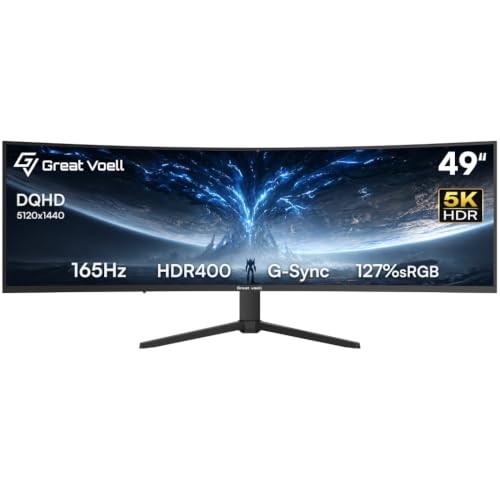


Key Specifications and Performance Factors
The core value of a 49-inch display lies in its ability to provide a massive field of view without the bezel interruption of two separate screens. Most models in this category use a VA panel, which offers high native contrast ratios, typically around 3000:1, resulting in deeper blacks and more vibrant colors compared to standard IPS panels.
This high contrast is particularly beneficial for single-player games with dark environments or for watching movies. The resolution is almost universally 5120×1440, which provides a pixel density that balances sharpness with the processing power required from your graphics card.
| Feature | Typical Spec | Impact on Use |
|---|---|---|
| Resolution | 5120×1440 (DQHD) | Sharp detail, high pixel count |
| Aspect Ratio | 32:9 | Seamless dual-monitor replacement |
| Refresh Rate | 120Hz – 165Hz | Smooth motion in fast-paced games |
| Curvature | 1000R – 1800R | Immersion and reduced eye strain |
| Panel Type | VA | High contrast, good viewing angles |
| HDR Support | HDR400 / DisplayHDR 600 | Enhanced brightness and color range |
Refresh rate is a critical differentiator for gamers. While 120Hz is a solid baseline, models offering 144Hz or 165Hz provide noticeably smoother motion, especially in first-person shooters or racing simulations. To achieve these high frame rates, you must use the DisplayPort connection, as HDMI 2.0 often caps out at lower refresh rates on these specific resolutions. Variable Refresh Rate technologies like AMD FreeSync or Adaptive-Sync are standard, helping to eliminate screen tearing and stuttering by synchronizing the monitor’s refresh rate with your GPU’s frame output.
Curvature is another major factor in user comfort. A 1500R curve is a common standard that mimics the natural curvature of the human eye, making the edges of the screen easier to see without turning your head.
Some premium models offer a 1000R curve, which is more aggressive and immersive but may require a specific viewing distance to avoid distortion. If you plan to use the monitor for extensive office work, a gentler curve or a flat panel might be preferable, though most 49-inch displays are curved to maximize the perceived field of view.
Panel Technology and Color Accuracy
VA panels dominate this size category due to their superior contrast capabilities. This is essential for HDR performance, as the difference between the brightest whites and the darkest blacks is more pronounced. Color gamut coverage varies, with many models exceeding 100% sRGB, which is sufficient for most gaming and general office tasks. For professional photo editing or video production, you should look for models that explicitly state high color accuracy and support for specific HDR standards like DisplayHDR 400 or 600.
Input lag and response time are also important for competitive players. A 1ms MPRT response time is a common specification that helps reduce motion blur. However, it is worth noting that response time claims can vary based on the testing method. For most users, the combination of a high refresh rate and a VA panel provides a responsive experience that is well-suited for both fast-paced action and static productivity tasks.
Connectivity and Ergonomic Features
Modern ultrawide monitors are designed to be hubs for your workspace. Many include USB-C ports with power delivery, allowing you to charge your laptop and connect your devices with a single cable. This is a significant advantage for users who want to keep their desk clutter-free. Additionally, most models come with a height-adjustable stand, which is crucial for maintaining proper ergonomics. The ability to tilt, swivel, and adjust the height helps reduce neck strain during long sessions.
Picture-in-Picture (PIP) and Picture-by-Picture (PBP) modes are standard features that allow you to display content from two different sources simultaneously. This is useful for multitasking, such as watching a video while working on a document or playing a game while monitoring a chat window. These features enhance the productivity benefits of the ultrawide format by providing a flexible workspace that can be customized to your specific needs.
Choosing the Right Curvature and Size
The ultrawide size is substantial and requires a dedicated desk space. You should measure your available area to ensure the monitor fits comfortably without overwhelming your workspace. The curvature also plays a role in how the screen feels to your eyes. A 1500R curve is generally considered a sweet spot for most users, providing enough immersion without causing visual fatigue. If you are sensitive to curved screens, you might prefer a model with a gentler curve, though these are less common in this class.
Viewing distance is another factor to consider. Sitting too close to an ultrawide screen can make the pixels visible, while sitting too far can make the text difficult to read. Most users find that a distance of 2 to 3 feet is ideal for this screen size. The high resolution helps mitigate pixelation, but the wide aspect ratio means that your eyes will travel more across the screen, which can lead to fatigue if the curvature is not optimized for your viewing position.
Performance in Gaming and Productivity
In gaming, the ultrawide format provides a tactical advantage by allowing you to see more of the game world at once.
- This is particularly beneficial in racing games, where you can see more of the track, and in strategy games, where you can manage more units on the screen.
- The high refresh rate ensures that motion is smooth, and the low response time helps keep the image sharp during fast movements.
- For console gamers, ensure that your console supports the 5120×1440 resolution or that you are comfortable with a lower resolution output.
For productivity, the seamless workspace is a game-changer. You can have multiple applications open side-by-side without the need to switch windows or manage a dual-monitor setup. This is especially useful for tasks that require reference materials, such as coding, trading, or video editing. The PIP and PBP features allow you to keep a communication window open while focusing on your main task, improving workflow efficiency. If you are considering a setup for office work, our monitor for office work guide offers more insights on display choices.
Common Considerations and Trade-offs
One of the main trade-offs with ultrawide monitors is the power consumption and heat output. These large displays require more energy to operate, which can impact your electricity bill and the thermal load on your room.
Additionally, the size of the monitor can make it difficult to transport or store if you need to move your setup. The stand is also a significant component, and while most are sturdy, they can take up a lot of desk space. If you have limited desk depth, you might need to consider a monitor arm or a different mounting solution.
Another consideration is the compatibility with your graphics card. To run a 5120×1440 resolution at high refresh rates, you need a powerful GPU. If you are using an older or less powerful card, you may need to lower the resolution or refresh rate to achieve smooth performance.
It is also worth noting that not all games are optimized for the 32:9 aspect ratio, so you may need to adjust the in-game settings or use a mod to get the best experience. This is a minor inconvenience for most users, but it is something to be aware of before purchasing.
Key Points for Your Decision
Before making your purchase, consider the following factors to ensure the monitor meets your specific needs:
- Check the maximum refresh rate supported via DisplayPort.
- Verify the curvature radius matches your preferred viewing comfort.
- Ensure the stand offers height and tilt adjustments for ergonomics.
- Look for USB-C with power delivery if you use a laptop.
- Confirm the HDR standard supported by the panel.
- Measure your desk space to fit the 49-inch width.
These points will help you narrow down the options and find a display that balances performance, comfort, and value. By focusing on these specific criteria, you can avoid common pitfalls and select a monitor that enhances both your gaming and productivity experience.
Ultimately, the right ultrawide monitor depends on your specific use case and budget. Whether you prioritize high refresh rates for competitive gaming or color accuracy for creative work, there are options available that meet these needs. Take the time to compare the specifications and features of the models listed above, and consider your own workspace and hardware setup. This will help you make an informed decision and find a display that you will enjoy using for years to come.







Write Your Review
No reviews yet. Be the first to share your experience!